I’ve been committed to advocating for women’s health and telling my story for many years now. I’ve experienced more than my fair share of gynecological challenges, from fibroids to challenges with fertility. Being diagnosed with vulvar melanoma last year just felt like the icing on the cake.
But if this had to happen to someone, it feels like it had to be me. And that’s because I refuse to be uncomfortable talking about women’s health and gynecological issues. I want to break stigma and raise awareness, to give back and support other women. Sharing my story is how I do that. It’s taken a lot of recovery and healing for me to get to this point, though.
Healing from my vulvectomy surgery was extremely painful, but what was surprisingly tough was the emotional recovery. I was so angry. After all the gynecological issues I’d already had, to have another made me feel like I was being punished. The vulva represents motherhood, sensuality, and femininity. To have that be physically changed was so difficult to process. I had some really challenging days – days when I didn’t want to get out of bed.
I’m grateful for the supports I had available, and that includes Look Good Feel Better (LGFB). Both of my parents are cancer survivors as well, and when my mom was going through her breast cancer treatment, one thing she always said was, “Look good, feel better.” She really believed in that. And the LGFB program was such a lifeline for me personally, too. It really turned things around for me when I was so low, so angry, and dealing with a lot of negative self-talk.
I felt so seen at the workshop. It was a beautiful community. The kindness and positive energy in that room were overwhelming – I was deeply moved. The volunteers were wonderful, the kit was amazing, but what really impacted me was seeing different women at all stages of their cancer journeys and just feeling extremely supported. I was worried that we’d all sit around crying about what we were going through, but it was the opposite of that – warm and upbeat instead of sad or solemn. And I left that day all done up and feeling like a million bucks.
I also attended LGFB’s Bubbles & Brunch fundraiser with my family and friends, which was incredible. It was a really great day. My husband and brother were both fabulously decked out for the cowboy theme – my brother wore a white cowboy hat and we joined the DJ on stage at one point. I cried happy tears so many times that day because I felt so fortunate to have all my friends who have supported me through all of this rallying around me.
I’ve been so lucky, so privileged on my journey. I was able to get time off work to have procedures done. I live close to excellent hospitals like Princess Margaret – I don’t have to make a big journey and pay for a hotel like so many do. I was able to get really good care, but so many people fall through the cracks.
Women’s health is so underfunded and neglected. There’s still so much stigma. And the injustice of the lack of access makes me really angry. Even accessing period products is so difficult if you’re unhoused or live in a northern community. And when it comes to gynecological cancers, we need to advocate for more self-examination and early detection. These things are incredibly important.
I feel like me getting vulvar melanoma happened for a reason: to help spread awareness. I’m not ashamed of my diagnosis or of what I’ve been through. We have to get comfortable talking about these things. Our lives depend on it.
Sarah’s Instagram: https://www.instagram.com/sarahelizabethclare/
I’m someone who has always been comfortable behind the scenes. In my career, I design corporate learning programs – I’m not the one leading the classroom. I like to be in the background, building the curriculum – creating change and quietly shaping experiences for others.
When I got breast cancer at 27, things changed. Suddenly, I couldn’t hide. Not from the diagnosis. Not from the mirror. Not from the fear.
I had to push for the diagnosis. I had a lump but was told it was probably nothing. I insisted on testing. When I got the news, my fiancé David – now my husband – and I were just completely shocked and devastated. I’d been living in this grey area of uncertainty prior to the diagnosis, and suddenly everything became very black and white. I searched desperately for someone like me – someone in their 20s, newly diagnosed, terrified and dealing with this cancer that has the stigma of being an old woman’s cancer. I kept scrolling on social media, hoping to find her, hoping to relate to someone. But I couldn’t. I felt so isolated, like I was the only one going through this.
When I finished chemo, I decided to become the advocate that I’d searched for so fervently. I wanted to create a community for other young people who are facing or have faced the same thing. I surprised myself by coming out from behind the scenes and putting myself in the spotlight. I opened TikTok. I turned the camera on. And I started filming.
On my TikTok account (@natorrico), I share what life after treatment is like – and what healing and thriving can look like. Creating this content is very healing. It’s very soft. I show my day-to-day life: relaxing nature walks with David and our miniature dachshund, Ozzie; tending to my houseplants; making nourishing, nutritious food; brewing the perfect cup of coffee; watching the sun pour in the window. There’s a lot of intentional self-care and romanticizing my routine. When I was going through my treatment, I wished that there was something like this, someone like me out there. I hope I can give comfort to someone else feeling anxious and wondering what their life will look like once they get through cancer. I want to show what’s possible, what’s next. There’s a lack of this type of space in the post-cancer experience. My goal this year is to become a breast cancer advocate – not just for myself, but for other women as well.
Breast cancer is so intense. It changed my identity – and deeply affected my confidence. I felt like my womanhood was being taken away. I wondered whether I’d still be able to have kids some day. And I would look at myself in the mirror and think, “Who am I?” I had always been Blonde Natalia, Natalia Who’s Always Running and Exercising – that’s who I am, or who I was – but I couldn’t be that person anymore. Things needed to change. I had to rewrite the narrative.
Look Good Feel Better supported me on this journey. The organization showed me the power of advocacy and community. It helped give me the courage to put myself in the spotlight – visible, vocal, and vulnerable – so that I, too, can support others.
Post-cancer Natalia is a very different person from pre-cancer Natalia. I know who I am now and what I want. After gathering up the courage to advocate for myself and speak up, I’ve really found my voice. I’m more independent, more confident, and better able to prioritize what’s truly important to me. I’m letting my natural red hair grow back – no more blonde. Getting cancer in one’s 20s is certainly not something I’d wish on anyone. It was a devastating experience for me. But there are good things that can come out of these situations, and I’m really embracing those good things now. I’ve come out of it learning just how strong and resilient I am, and I couldn’t be prouder of myself.
Natalia’s Instagram: https://www.instagram.com/natorrico
Cancer runs in my family — it has affected six out of eight siblings, my mom, my aunt, my grandmother, my cousins, and even my niece and nephew. But I’ve never let it define me. I don’t even like to use the “C” word — I call it “the unwelcome intruder.” It infiltrated my body and so now we’re just working on getting it out of there. I don’t allow it to control me or have authority over my body.
Throughout my treatment, some things have stayed constant in my life, and this grounds me. I’ve kept working, because I love my job and it gives me a sense of normalcy. My children are there for me — I’m a single mom of four kids, 22-year-old triplet daughters and a 24-year-old son. I love going on walks with my little nine-year-old Havanese and reading psychological thrillers.
My faith has been another constant source of strength. When I had a recurrence of the unwelcome intruder, I prayed a lot. I was like, “I can’t go through this a second time. Lord, what are you doing?” And I received a message saying that this was not a journey I was to take alone — that this was going to be a community-based journey for me. I have a habit of isolating myself, especially during times of struggle. Thanks to this message that came through, I’ve been staying connected and sharing my journey, especially through the women’s connect group at my church. We all go through struggles in our lives, and my hope is that by sharing mine, it’ll help people to see their own challenges in a better light and to know they’re not alone or stuck. I know there’s an end to this.
It wasn’t just my church community, either. Once I decided to overcome my habit of cutting myself off from others, I was surprised at how vast this community travelled. More and more people outside of my church, outside of my faith, have come to walk alongside me. They send texts, stop by, bring me meals, go for walks with me, and even attend appointments. It has been really uplifting, encouraging, and inspiring. I feel held and supported.
This community extends to Look Good Feel Better (LGFB) as well. Losing my hair was a big thing for me. I cried and cried for weeks on end in anticipation. I just turned 61, but I don’t feel old —and I didn’t want to look old, or sick. My hair started falling out just two days before my LGFB workshop. I felt really shut down. I almost didn’t go. But I’m so glad I did, because the workshop really helped me get through it.
I loved how the volunteer talked about hair loss — so calmly, so casually. She’d rip off her wig, put on another, and then switch to a bandana. Something opened up in me when she was doing that. It felt so freeing. I realized I was no longer stuck to my hair, and that it was okay that it was gone. My hair falling out felt like the end of the world for me, but the workshop helped me realize that hair is just hair. It doesn’t define who I am. This new perspective changed the entire trajectory of my journey. The workshop gave me my life back, basically. It was so empowering. As a bonus, I’ve been having a lot of fun with wigs, trying different hair styles and colours.
My positive mindset has really helped me through this journey. Prayer, connection, community — these have been instrumental. And I really do treat this as a journey — not just a medical, physical journey but also a mental, spiritual, soul-deep transformation. I don’t have to worry about the unwelcome intruder in my body because that’s what my medical team does. My responsibility is to make sure that I’m staying as healthy as possible, physically and mentally. I’m not just focusing on the cancer, but on making myself better.
When I first started experiencing unusual symptoms – constipation, bloating, heartburn, abdominal pain – in the summer of 2024, my first instinct was to put pen to paper. I drew a diagram of my body and wrote down all the things I’d been feeling. That’s the art therapist in me. When I showed the illustration to my doctor, she immediately recognized the signs of ovarian cancer. A CT scan revealed a large tumour over my right ovary, confirming her suspicions. I was completely shocked and devastated.
My career as a clinical counsellor and art therapist with preteens and teenagers abruptly stopped when I was diagnosed. It was such positive and enjoyable work. And not only did I have to leave my private practice, I had to stop doing things that gave me pleasure and joy in life.
I love being active: Zumba, belly dancing, strength training, circuit training. I also enjoy cooking wonderful food and travelling. But quite suddenly, my life was now filled with endless medical appointments. Testing, scans, blood work, chemotherapy, surgeries. It was surreal.
With my psychology background, I knew I had to look after the other parts of myself. The physical was being cared for. What about my emotional self, my sense of self, and my need for connection?
It had seemed that all the joyful activities in my life had come to a halt, but I was able to resurrect some activities that I hadn’t done in a while – things that I could go back to. Those included reading and art. I love art, especially drawing and painting with watercolours, and it has always been my resource during the tough times in life. It’s a wonderful outlet for sorrow and other emotions that need to be released.
I had no words for what was happening to me, and so I started to draw. I drew myself sitting in the middle of a tsunami wave – the tsunami of grief after diagnosis. I painted myself at nighttime in a jungle, with moonlight pouring down – standing in the garden of hope. I created more and more art, navigating the back and forth between despair and hopefulness.
I also talked with my caring partner, Bill. I cried a lot. I got a counsellor. I connected with friends. And I found community. When I first heard about Look Good Feel Better (LGFB), from a woman in the cosmetics department at Shoppers Drug Mart, a little spark went off. I signed up right away. At the workshop, I was amazed by how supportive it felt to be in a space with other women who I could relate to. I wasn’t alone – we were all going through it. The workshop was so informative, helpful, positive, and uplifting – something I dearly needed. And with my body having surrendered to all the necessary medical procedures, learning how to use makeup to my advantage was a way to take back my sense of dignity and to connect with my femininity.
LGFB brought me a respite from my sorrow and loss. It was a bright light, bringing a sense of community and breaking the isolation I was feeling – just like my art. Body, mind, and spirit are all integrated parts of us, and throughout my cancer journey, what really needed tending was my emotional side. It was stormy and intense – it needed to be expressed. We don’t have to be positive and brave all the time.
I can’t control everything, but I can control how I care for myself. Eating well, staying connected, and doing things I enjoy – reading, creativity – have made all the difference.
By Adriana Lombardo
I went for chemotherapy at Princess Margaret Cancer Centre once a week for two years.
The first time I went I didn’t realize I’d spend a full day there. I didn’t know what to pack at first. I brought along one water, a granola bar, and a book to my first chemo appointment.
Soon afterward, the nurse explained to us that although you may have a “set-time” for blood and chemo, it doesn’t necessarily mean that that is when you get called in. She told us that it takes a while for the blood results to come back and once they are cleared by the nurse practitioner, then chemo gets ordered.
Once chemo gets ordered, it’s a matter of the pharmacy making the order, which takes time.
From that day on, I always made sure to pack my favorite items that I always kept on-hand – not only for chemo, but wherever I went during treatment.
Crackers & Other Dry Goodies
I was on steroids for two years and a bit.
It was brutal during my intensification phase (30 weeks of high dose steroids) where I usually had heartburn or nausea and needed to munch on something dry to feel better.
Crackers were my go-to and always a staple item to have in my bag because I just never knew when I’d get the steroid munchies.
Other dry, salty goodies like popcorn or even bread, made it a lot easier to keep my hunger at bay most of the time…seeing as I was hungry all the time.
Let’s be honest, I always carried some sort of food on me whether it be sandwiches, rice, or leftover pasta.
I would whip it out of my bag and set myself up with a mini picnic.
Different Hats
I had purchased a wig at the Wig Salon at PMH but I only wore it twice because I preferred to go bald and just wear hats out of comfort.
I purchased pretty much every single hat in that store and then some!
I liked carrying around different style hats to change into whether at the hospital, at an appointment or while I was out.
At one point of treatment, changing hats for me was like changing shirts and never knowing which to wear because I just had too many options…yup, that was me! But hey, it’s not like I can’t transition them into everyday hats now that my hair is back.
Chapstick & Moisturizer (LOTS OF IT)
I expected skin changes as one of the side-effects, but because it was the winter time, I had extra chapped lips and extra dry hands. I had to reapply my Chapstick at least three times within the hour and constantly moisturize my hands to prevent them from cracking.
Water
While taking steroids, I found it extremely difficult to keep up with any hydration because everything tasted like metal to me, but I knew I’d regret it if I didn’t try and force myself to drink because then it would lead to other problems…if you know what I’m saying.
At least carrying the bottle with me would encourage me to drink it, not only because it made my bag heavier (motivating me to finish it), but also because it stuck out of my bag, so I knew it was always there right in front of my face.
Sunscreen
Anyone and everyone should always make sure to apply some sort of protection to their skin.
I never thought that I’d start wearing sunscreen during the winter months, but I had to once I learned about all the risks associated with sun exposure during chemotherapy.
As much as it scared me, it put me in place knowing that I needed to constantly reapply it, even if I was just driving around in the car.
Now, it has just become a habit of mine to always apply it in the morning and carry it in my bag to reapply it throughout the day. The small travel size options, or the ones that come in the Look Good Feel Better kit are a great size to have on you.
Antibacterial Soap/Wipes
“Disinfect everything!” are the words that stuck with me throughout my entire treatment.
The nurses made it very clear that germs loved me at this point – being immunosuppressed and all.
I was susceptible to catching anything, so I had to make sure that my hands and any surfaces were always clean.
It was embarrassing at first, having to disinfect tables at the mall in food courts if I went to buy a coffee with family or friends, being extremely cautious in public bathrooms, and even if I was having a picnic at parks…people looked at me funny but I knew I had to be careful. Maybe my actions remind them of the pandemic.
I grew used to the idea of being “safe,” and embraced what I was going through when I had to do it.
If people looked at me funny or stared, I’d smile and say, “I know, right!? How can someone fighting cancer and going through chemo look this great bald?” or “I pay my oncologist big bucks to look the way that I do.” *wink*”
People thought I was ridiculous, but what did I care. I was going through this, not them, so there was absolutely no need for it to bother them in any way, shape, or form.
Just learn to laugh about it and then people will laugh with you.
Books/Magazines & Entertainment
You need to pass the time somehow. During treatment, I grew to love psychology and self-help books. I found them to be quite insightful at this point in my life. I was already going through a life-changing experience, which made me begin to question everything, so I decided to take that time and re-evaluate my whole life and give it a makeover.
Plus, I always had my cellphone on me for social media, games, and texting.
Make sure to carry around things like books, magazines, or crossword puzzles, because you’ll find you’ll have a lot of time on your hands while going to treatment or other appointments. You might as well make the most of it.
Vitamins/Medication
I always found myself to be out and about at the point when my medication or vitamins were due. I found it a lot easier to just carry them around in a cute little makeup bag that I had purchased solely for that purpose. That kept everything safe, clean, and in a place that I knew would always be in my bag.
I’ll never forget my first interaction with Look Good Feel Better (LGFB). It was about 20 years ago, when I was first diagnosed with breast cancer. Going to the LGFB workshop was my best day at the cancer centre. Most of my time there wasn’t cheerful or enjoyable, but my experience with LGFB was just lovely. The people were so kind and helpful, and it was great fun. I look back on it fondly.
I got diagnosed with cancer again last year. This time it was what doctors called a “complex case”: three distinct cancers – endometrial, ovarian, and fallopian – in three different places.
One of the first things I did was to connect with LGFB again and sign up for a workshop. Getting to attend the workshop again, after all these years, was a shiny, happy moment in my cancer journey. Who knew that chemotherapy could include highlights? It was the same supportive experience with people who were genuinely interested in helping me feel my best. I loved how they now provide a helpful booklet with makeup tips, so I didn’t have to take notes during the workshop.
The workshop isn’t really about makeup or skincare for me, though. It’s about the opportunity to chat with other people going through the same experience. And to have a good time – for example, everyone had a good giggle with some of the ladies modelling their wigs and making wonderful faces in the mirror. Sometimes, we just need a day where we’re thinking about nothing other than having fun. There’s no other agenda. It was so helpful in terms of my spirit – just enhancing my mood and joy. It’s more beneficial than therapy or a self-help group for me. LGFB cultivates such a supportive, uplifting environment. It was a very restorative afternoon – such a gift, truly. Whoever came up with this idea deserves immense credit.
Cancer and its treatment affect us all so differently. They can tell you what to expect during chemotherapy, but you never really know what’s coming your way until it’s there. It’s the same way with how cancer treatment’s side effects impact our appearance and self-esteem – it’s so individual. We may respond with acknowledgement or disbelief or rejection or anger. There’s a plethora of possible responses.
In a way, I think it comes down to your willingness to accept your own reality. My personal attitude is one of total acceptance. “It is what it is” – that’s my mantra. I look at whatever’s happening in my life – cancer treatment, or a broken shoelace, or a scenario in one of my past careers in education and social work – and I assess what’s going on and how to deal with it. How best can I move forward? What’s my next step? What’s the most useful and functional response to a situation? Is there a possibility to enhance the situation, to make it better?
That approach has served me well in life, and it’s serving me well now. I change the things I can change, and accept the things I can’t. I like to be realistic about what’s possible.
These days, I’m looking forward to what’s next. I’ve finished my treatment and I’m enjoying being retired. I love to make art – I also teach watercolour classes – and to spend time with my grandchildren. I’m looking forward to getting back to travelling, and specifically to going on a cruise. I just want to be on a ship somewhere warm. I love cruising, it’s my favourite thing. No cooking, no cleaning, just art classes, ocean air, and leisurely afternoon naps. And if I can’t be on a ship just yet, I’ll take an afternoon like the one LGFB gave me any day – one with kindness, laughter, and light.
Working as an oncology nurse has been my dream for so long. Losing my mom to breast cancer definitely influenced my decision to work in oncology and my desire to help people. It’s incredibly rewarding. But one thing’s for sure – I never expected to be on the other side of the diagnosis, facing cancer myself.
I especially didn’t expect it at just 30 years old – and 24 weeks pregnant with my first child. My mom passed away when I was only two years old, and to suddenly get the same diagnosis while I was on the verge of becoming a mom myself was beyond terrifying. I practically blacked out when I heard the news. I kept thinking, “What? I’m pregnant. This isn’t supposed to happen.” It was quite the curveball, to say the least.
While it was the most difficult news to receive, I’m so grateful they caught it early. I’m thankful that there were chemo medications I could take that were safe for my unborn son. I have the most phenomenal doctors and nurses – my colleagues in the cancer centre in Sudbury, Ontario, became my caregivers overnight. I have a wonderful support team through my husband, Ryan, and my step-mom, who I really think of as my mom, as she’s been a mother to me my whole life. She has been my rock. And this whole ordeal has given me a completely new perspective on facing cancer, despite the fact that I’ve cared for cancer patients for seven years now.
For example, although I supported cancer patients in their journeys everyday as a nurse, I underestimated the mental and emotional toll that cancer treatment would have on me. For one, losing my hair was so tough. I had always been like, “Oh, it’s just hair, it’ll grow back.” But it’s not just hair. It was part of me and my self-esteem and how I presented myself to the world.
I already knew about Look Good Feel Better (LGFB) through my work in the chemo room, and it became such a valuable resource for me. I signed up for a workshop right away, and boy, was it ever awesome. As a nurse, I had often heard about the impact of LGFB but experiencing it firsthand was completely different. Like losing my hair, I didn’t fully grasp how much it would mean to me until I was living it.
I took my mom to the workshop as my support person, and it was so good for the soul. I learned some great hair and makeup tips, but more than that, it gave me a powerful sense of hope. It helped me reclaim my self-esteem and made the scary experience I was going through feel a whole lot less scary. I loved connecting with other women who were going through what I was going through. Having cancer can feel so lonely – I had all the support in the world, but people didn’t really understand what I was going through, because, well, they didn’t have the diagnosis. Being able to share my experience with the women in the workshop was really special.
I’m so grateful that LGFB exists, and that my future patients will have the opportunity to attend the workshops. And now, I can speak to the experience personally. When I’m able to go back to work, I know I’ll be able to connect with and support my patients on a whole new level.
My son, Matthew, has arrived, and things feel so much better now. A lot of the anxiety and fear of the unknown that I experienced – about cancer, about being a first-time mom – have faded. This journey has given me a deeper understanding of resilience, both for myself and my patients.
By Adriana Lombardo
Let me be blunt with you. These past few months have been crap – to put it politely.
Only now is it hitting me: Survivor’s Guilt.
Why did I survive a deadly disease while I had to bury people I’ve met along the way?
Why am I finding it so difficult to move forward with my life without feeling extremely guilty?
This sucks!
I knew this feeling may come. I’d heard of survivor’s guilt and was aware of the emotions I had yet to face, but to be honest with you, I had started living and actually enjoying life without having to worry about appointments, etc, that I didn’t think it was going to happen.
I thought I was one of the lucky ones who wouldn’t go through it – who am I kidding.
As sad as this may be, or as weird as it may come across, I miss having cancer.
Weird, huh?
Who would ever say such words?
Let me explain:
Life was easier when I was sick; at least it seemed to be.
I didn’t have much to worry about other than chemo, appointments, procedures, if the cancer was going to kill me or not, you know, the usual “cancer stuff.”
Now that I’m back “in the real world,” I find myself struggling to accept that chapter has now closed.
It was two-plus long years of fighting and not having any worries about anything other than me.
I’ve moved on, almost as if nothing ever happened, but I find myself holding onto anger and pain and all these other emotions that I have never accepted until now.
I smiled all throughout my treatment – a genuine smile – but now I find I’m faking one to show people that I’m still alright.
How do you explain to people that while going through cancer I was genuinely doing fine, but now I feel as if I’m not?
I know it’s not up to me to explain this to anyone but that’s the thing about society – once you’ve gone through any sort of heartache, they expect you to pick up and keep going without actually acknowledging what you’ve gone through.
But that’s just it: once you’re “healed” or “cured”, people stop asking how you are because they assume everything is alright. That you’re “back to normal”.
I’m still trying to figure out my new normal while juggling these emotions.
It saddens me to know I had to remove my rose-coloured glasses at such a young age and that the benefit of the doubt doesn’t really exist once you’ve gone through cancer.
You see things and people for what and who they really are.
Anger and frustration followed.
Like I mentioned earlier, there are a lot of emotions that I’m battling now with Survivor’s Guilt.
It’s a matter of finding a balance between not letting go and moving forward.
I’m going to challenge myself for the next month. My goal is not to have it all figured out, but to accept what I’m feeling and just let myself feel it.
No one will ever have it figured out, so why should I?
I’m not sure that I’ll figure out why I’m feeling the way that I do, but I do owe myself ways of figuring out how to deal with it.
It’s going to be challenging but I’m going to learn to love myself all over again for the sake of my mental health and wellbeing.
I thought I had moved on. I thought that my cancer journey was behind me — far in the past. When a routine mammogram led to a new breast cancer diagnosis in 2023, it was a complete shock. My cancer had recurred after 13 years.
At first, I beat myself up over the diagnosis. I thought I had been doing everything right — eating well, working out, taking care of myself. “What did I do wrong?” I wondered. “How could this have happened?” I started to doubt my every move, every bite that I put in my mouth. My self-confidence declined. But I quickly realized that blaming myself wasn’t going to help. I had to act. I needed to take back control.
This time, I chose a double mastectomy with reconstruction. It felt like the safest option — I didn’t want to rely on mammograms anymore. And although I was reluctant to undergo chemo again after my painful first experience, I knew it was necessary. Thankfully, the treatment was a little easier this time. I received a new scalp cooling treatment that helped prevent hair loss, which made a huge difference for me emotionally. Though the chemo still brought its challenges — nausea, fatigue, and rashes — keeping some of my hair helped me feel like I hadn’t completely lost myself to the disease. Scalp cooling was a new innovation that hadn’t been available to me the first time around, so I was grateful for the opportunity to try it out.
Building a support system was also a priority for me. I’m from Mauritius, a tropical island off the coast of South Africa, and most of my family is still there, so I had to create my own network here. I discovered Look Good Feel Better (LGFB), and attending their workshop made a huge difference. My “look” is very important for me, and it was comforting to feel pampered and cared for, especially after all the blows and bad news I’d been receiving. The workshop helped me to regain confidence and connected me to a group of women who understood exactly what I was going through.
I also started a walking group for cancer patients and later joined a dragon boat group for breast cancer survivors. Looking at the strength of these paddlers made me feel strong, too. If they can do it, so can I. It was encouraging. After my first cancer experience, I was eager to move on and forget about it. But now, I realize there’s power in staying connected with the cancer community and with other survivors. I’m a two-time survivor. This is my life and my reality, and I accept it now.
This time, my son also played a bigger role in my recovery. He was just a toddler the first time I had cancer, but now, as a teenager, he became part of my support system. He loves photography, and whenever I did my makeup, he’d take photos of me and edit them. It made me feel good about myself and it became our bonding time, and those photos now hold a special place in my heart.
Today, I cherish every moment with my husband and son. We cook, go for walks, shop, watch movies — those little everyday moments mean everything to me now. I’m grateful for each day and, rather than cry about what happened to me or worry about the future, I choose to live in the present. Cancer may be part of my story, but it doesn’t define who I am.
By JC Chessell
It’s funny – as I sit here about to blog on my ‘expertise’ with hats and scarves, I find myself wearing a knitted toque aptly placed on my head. I do not know which came first: my love affair with hats or the loss of hair, which led me to my love affair of hats. Whichever it is, I still find myself wearing hats and head coverings A LOT. And I love it!
Today, I wear them out of personal freedom and choice but wearing hats during my treatment is forever a memory etched on my heart. Having cancer made it less of an option and more of a necessity for me to wear hats, but I enjoyed the look and the way they warmly protected my head.
I’d like to share my personal guide to “Covering Your Head During Cancer Treatment”.
Let’s say you’ve just been diagnosed and are thinking of covering your head with SOMETHING. You will discover there are various options for your head covering: hats, scarves and wigs (natural and synthetic).
Having so many choices gives us each more control as we move through our personal journeys. You will find that having a head covering, such as a scarf or hat, gives such a nice, quick pick-me-up and you may feel better about yourself and your outward appearance.
I mainly wore hats through my chemotherapy and radiation sessions. I kept my natural-hair wig for special occasions, like weddings and events.
Since I was diagnosed at the end of summer going into fall and cold winter weather followed, practically speaking, hats were my favourite and most sensible option. As you decide which head covering to go with, try to think about what look you want to present.
Hats give us SO many options, from fun and sassy to a more laid-back, practical type of look. You will see how your face changes as you wear different shapes, from the wide-rimmed to the smaller fisherman cap. And it only takes a second to put on a hat. Again, the choice is yours.
Scarves, I find, are a better option for spring/summer weather. Your scalp has breathing space due to the softer fabrics and overall, scarves have a lighter feel on the head. If you allow your imagination to run really wild, you can create a gorgeous scarf ‘up-do’ with layers of different scarves, thus allowing for height and dimension to frame your face—think Eryka Badu.
If you are deciding on a scarf option, my only advice would be to stay away from silk since the fabric slides off easily on bald or short hair scalp and will become more of an annoyance rather than anything else. The rest is up to you. And this is really where you get to play up different looks
Thankfully, new companies pop up offering us so many options with fabrics, colours and texture. And here’s a little do-it yourself tidbit: go to Fabricland, pick out a pattern that catches your eye—one that speaks to you. Ask the sales associate to cut off a specific amount of it (enough to wrap around your head at least twice) and make into a headscarf yourself. You may need to practice the wrapping a few times but soon enough, you’ll be an expert.
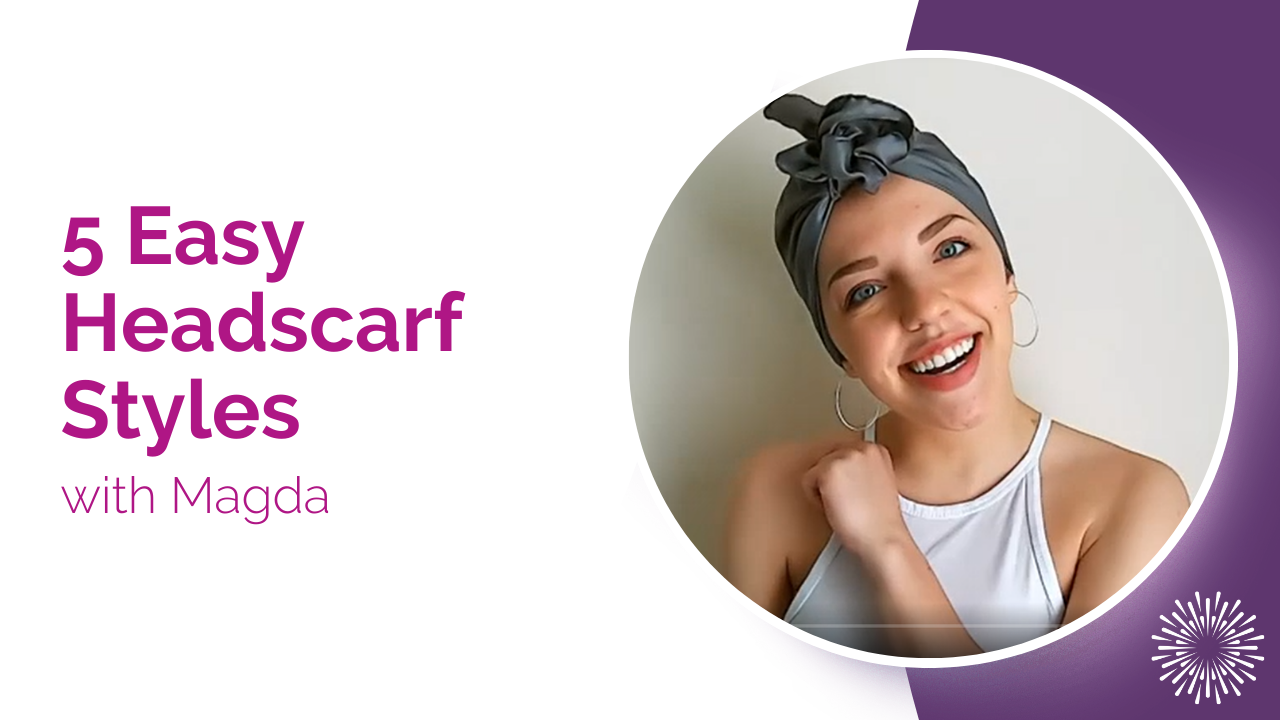
You should know that Look Good Feel Better workshops offer head/scarf wrapping info catering specifically to you and me, so that we can become more comfortable with how to wear our scarves in different ways. There are also lots of scarf-tying tutorials on YouTube, to give you even more ideas. You can start with this from Look Good Feel Better.