
Skincare & Makeup Workshop
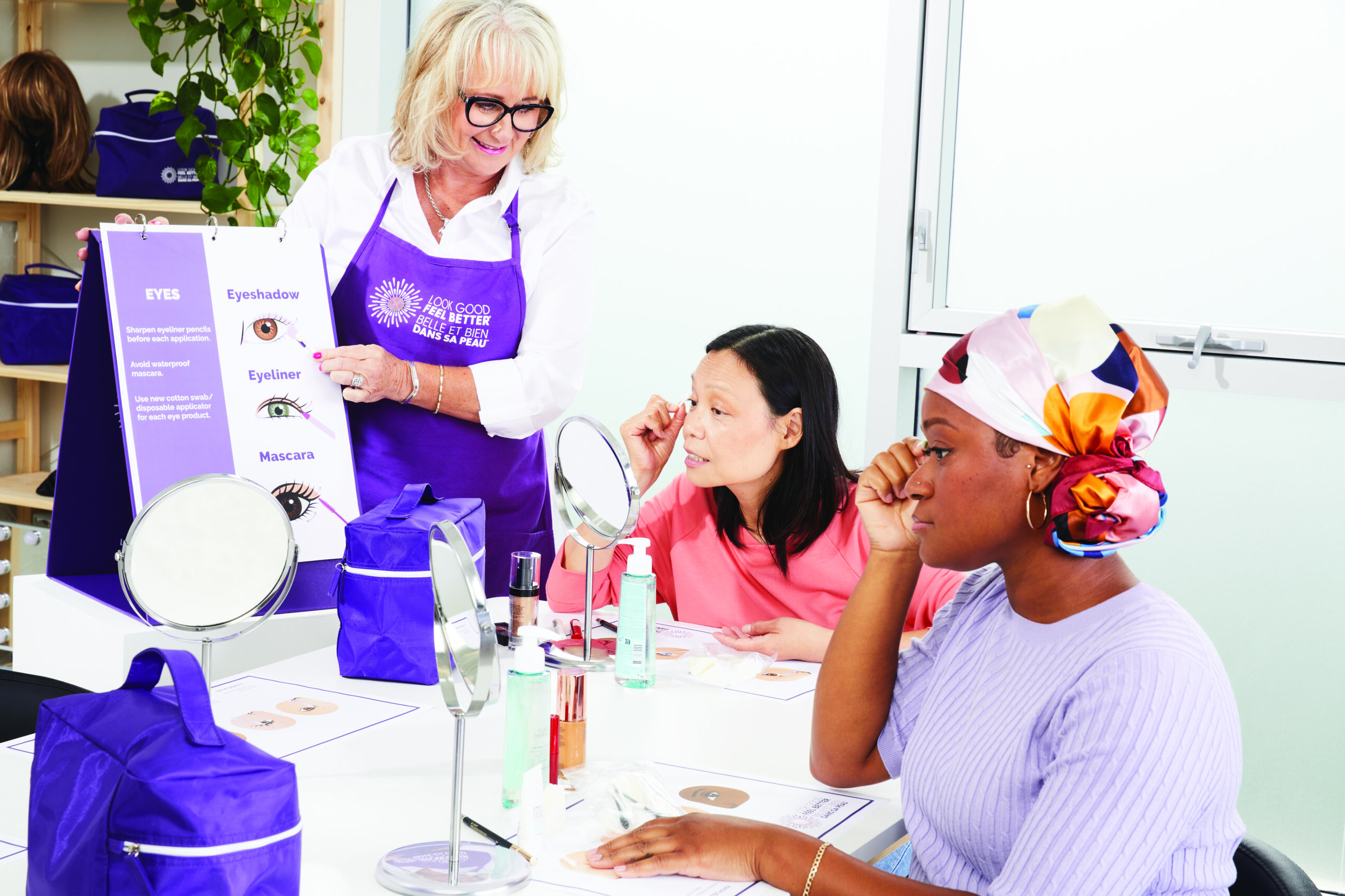
Discover practical ways to manage the physical side effects of cancer treatment on your skin, hair, and face, including skincare, makeup, hair loss, wigs and other head coverings. Available online or in-person.
About this workshop
What you will learn:
Counteract side effects such as discolouration and dry skin
Find tips and techniques for managing the loss of brows and lashes
Practice simple makeup steps to add colour back to your face
Makeup hygiene and sun safety
The information and dialogues are designed to help you:
Manage the physical side effects of cancer treatment with clear, practical guidance.
Connect with others who may understand what you are going through.
Understand what to expect during treatment.
Prepare for treatment to help minimize potential side effects.
Feel more like yourself again.
This workshop is available ONLINE and IN-PERSON.
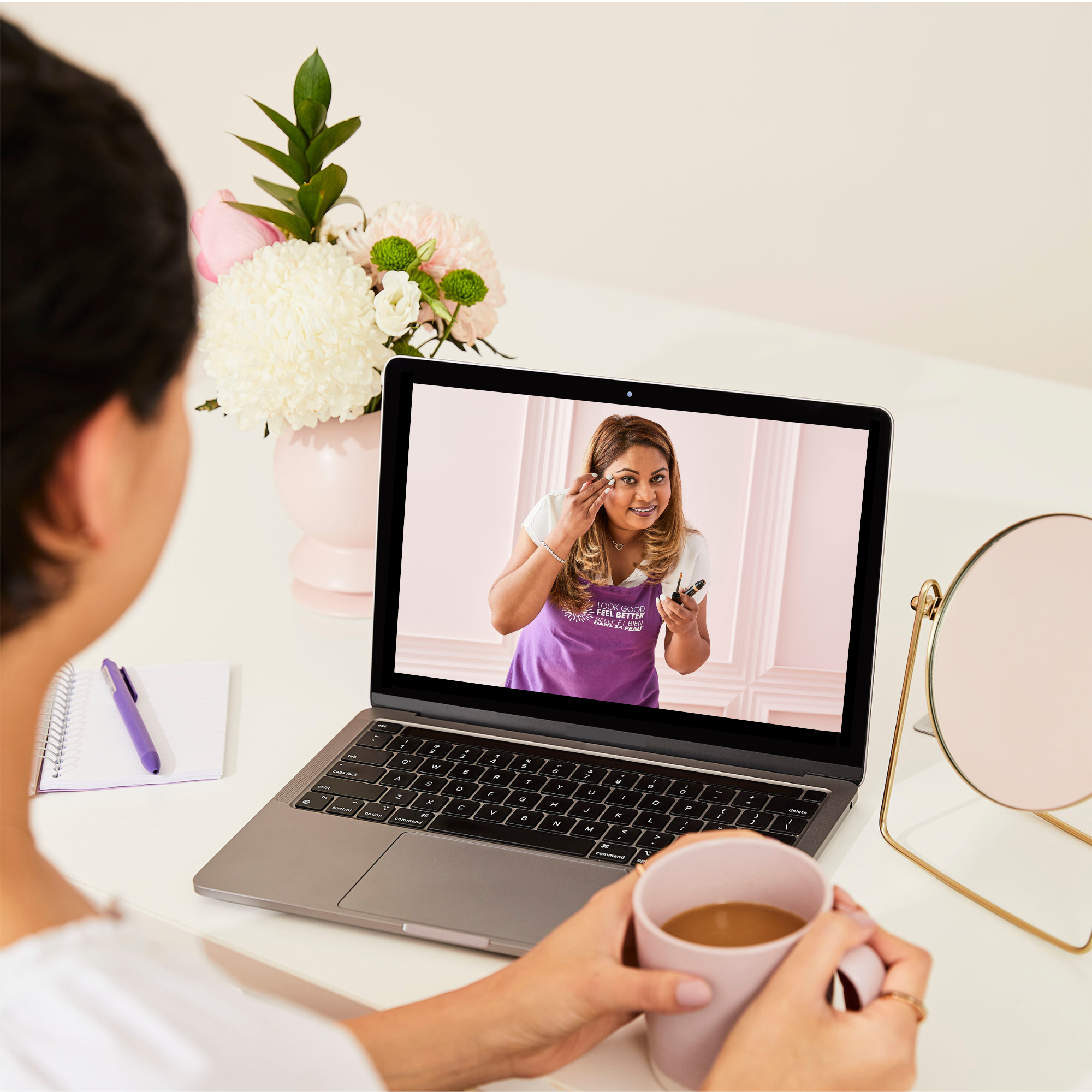
ONLINE
- The ONLINE workshop is one hour long and is delivered via Zoom.
- Relax and learn from the comfort of your own home.
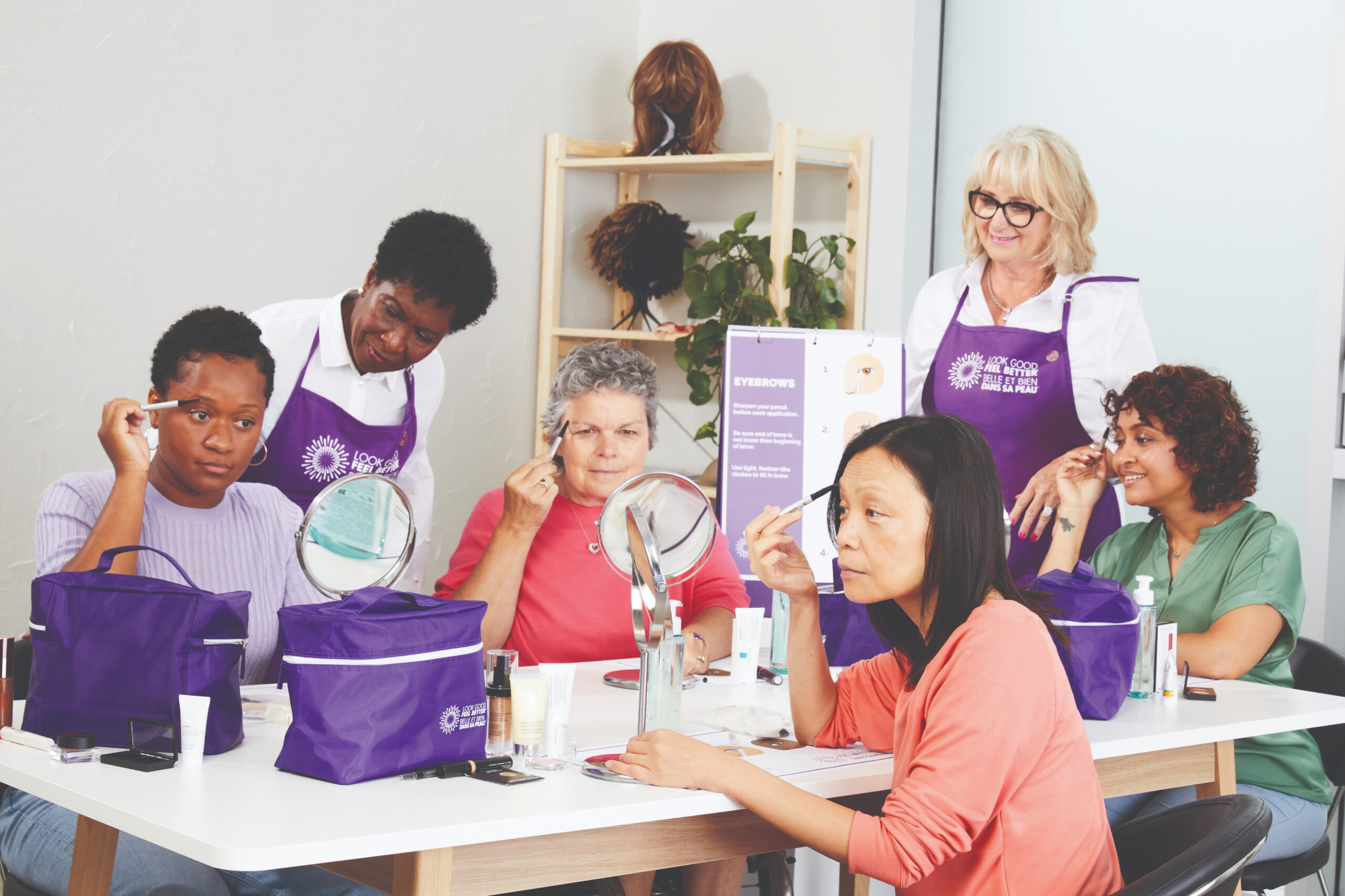
IN-PERSON
- The IN-PERSON workshop is 2 hours long.
- Called Skincare, Makeup & Hair, it combines both our Skincare & Makeup and our Wigs & Hair Alternatives workshops.
- In-person workshops are only available in select locations around Canada.
Who should attend this workshop?
This workshop is available to anyone who is:
- about to start cancer treatment
- is currently in treatment or
- has completed treatment in the last 12 months and would like information about or support around this topic.
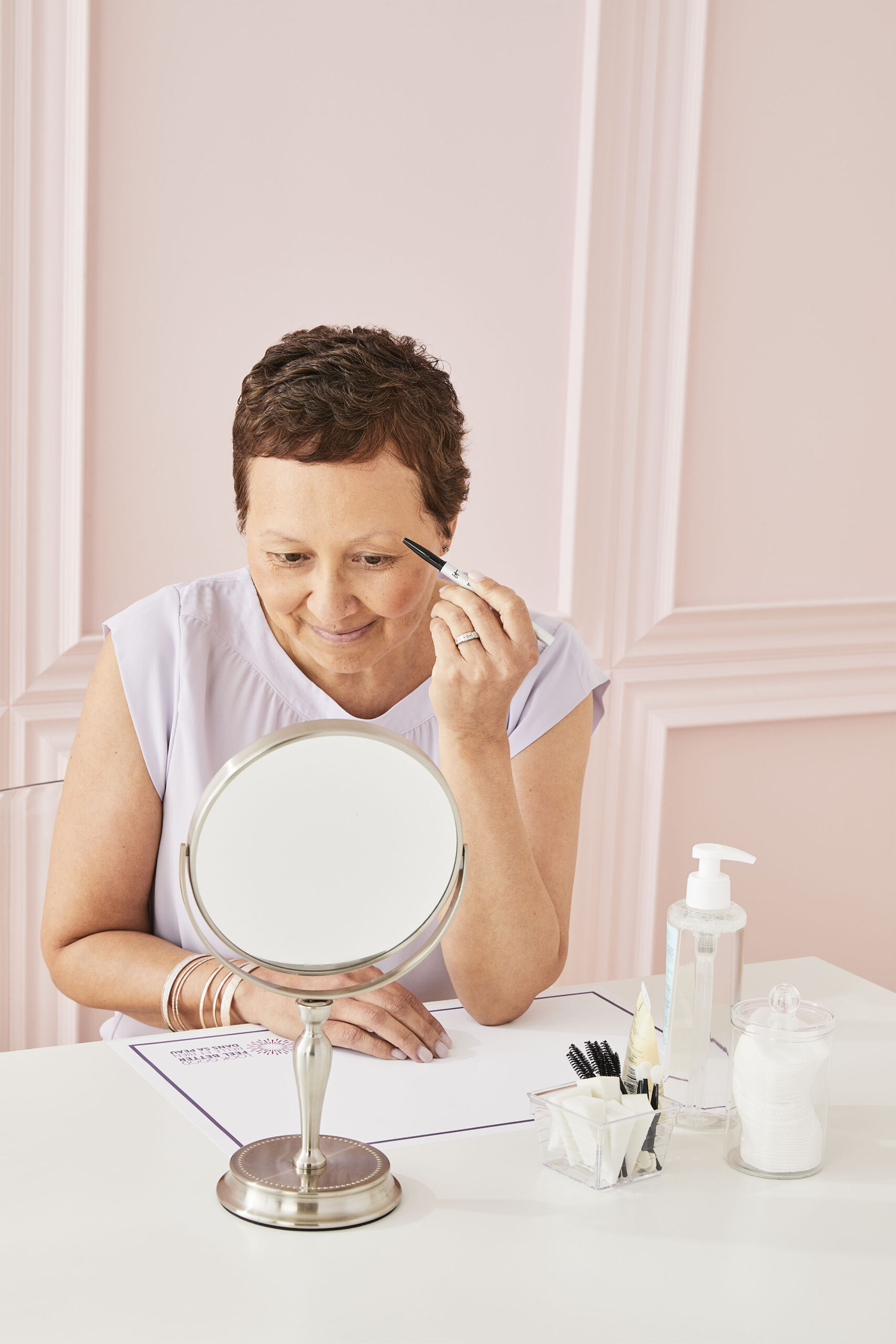
The Confidence Kit
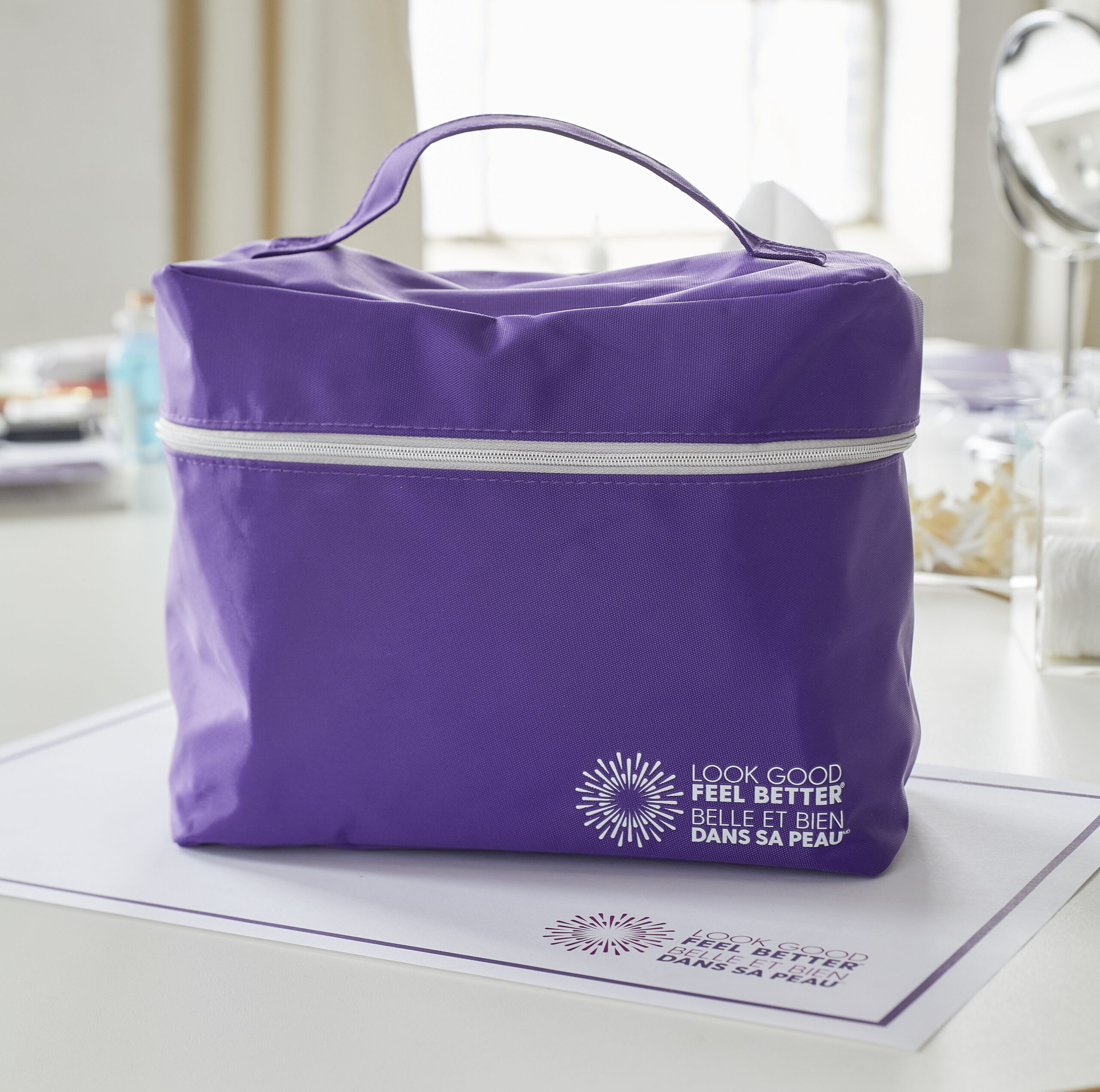
Participants in the Skincare & Makeup workshop receive a free kit of skincare and cosmetics products.
These products are generously donated to Look Good Feel Better and meet the regulations set forth by Health Canada.
These products are for educational purposes, so you may practice the techniques explained in the workshop.
- In-person workshop: You will receive the kit in the workshop.
- Online workshop: The kit will be shipped to you. It generally arrives 15-20 business days AFTER the workshop.
What Our Participants Have to Say
” This workshop was so useful because it wasn’t just information. It ‘normalized’ the techniques to cope with cancer & treatment related challenges to appearance. Yes, wear makeup and take care of your skin not just in spite of cancer and treatments but because of cancer and treatments! Here is how to do it well and safely!”
- Mirabel R., Workshop Participant
Participating in our workshops
97%
of Workshop Participants
would recommend our workshops to another person facing cancer.
32%
of Our Participants
feel somewhat confident BEFORE our workshops.
89.1%
of Our Participants
reported feeling somewhat confident or confident about their appearance AFTER our workshops.
Let’s navigate this together
Join a community that understands. Receive expert advice, useful resources, and compassionate tips throughout your cancer journey in the LGFB newsletter
Newsletter Form
Working as an oncology nurse has been my dream for so long. Losing my mom to breast cancer definitely influenced my decision to work in oncology and my desire to help people. It’s incredibly rewarding. But one thing’s for sure – I never expected to be on the other side of the diagnosis, facing cancer myself.
I especially didn’t expect it at just 30 years old – and 24 weeks pregnant with my first child. My mom passed away when I was only two years old, and to suddenly get the same diagnosis while I was on the verge of becoming a mom myself was beyond terrifying. I practically blacked out when I heard the news. I kept thinking, “What? I’m pregnant. This isn’t supposed to happen.” It was quite the curveball, to say the least.
While it was the most difficult news to receive, I’m so grateful they caught it early. I’m thankful that there were chemo medications I could take that were safe for my unborn son. I have the most phenomenal doctors and nurses – my colleagues in the cancer centre in Sudbury, Ontario, became my caregivers overnight. I have a wonderful support team through my husband, Ryan, and my step-mom, who I really think of as my mom, as she’s been a mother to me my whole life. She has been my rock. And this whole ordeal has given me a completely new perspective on facing cancer, despite the fact that I’ve cared for cancer patients for seven years now.
For example, although I supported cancer patients in their journeys everyday as a nurse, I underestimated the mental and emotional toll that cancer treatment would have on me. For one, losing my hair was so tough. I had always been like, “Oh, it’s just hair, it’ll grow back.” But it’s not just hair. It was part of me and my self-esteem and how I presented myself to the world.
I already knew about Look Good Feel Better (LGFB) through my work in the chemo room, and it became such a valuable resource for me. I signed up for a workshop right away, and boy, was it ever awesome. As a nurse, I had often heard about the impact of LGFB but experiencing it firsthand was completely different. Like losing my hair, I didn’t fully grasp how much it would mean to me until I was living it.
I took my mom to the workshop as my support person, and it was so good for the soul. I learned some great hair and makeup tips, but more than that, it gave me a powerful sense of hope. It helped me reclaim my self-esteem and made the scary experience I was going through feel a whole lot less scary. I loved connecting with other women who were going through what I was going through. Having cancer can feel so lonely – I had all the support in the world, but people didn’t really understand what I was going through, because, well, they didn’t have the diagnosis. Being able to share my experience with the women in the workshop was really special.
I’m so grateful that LGFB exists, and that my future patients will have the opportunity to attend the workshops. And now, I can speak to the experience personally. When I’m able to go back to work, I know I’ll be able to connect with and support my patients on a whole new level.
My son, Matthew, has arrived, and things feel so much better now. A lot of the anxiety and fear of the unknown that I experienced – about cancer, about being a first-time mom – have faded. This journey has given me a deeper understanding of resilience, both for myself and my patients.
By Adriana Lombardo
Let me be blunt with you. These past few months have been crap – to put it politely.
Only now is it hitting me: Survivor’s Guilt.
Why did I survive a deadly disease while I had to bury people I’ve met along the way?
Why am I finding it so difficult to move forward with my life without feeling extremely guilty?
This sucks!
I knew this feeling may come. I’d heard of survivor’s guilt and was aware of the emotions I had yet to face, but to be honest with you, I had started living and actually enjoying life without having to worry about appointments, etc, that I didn’t think it was going to happen.
I thought I was one of the lucky ones who wouldn’t go through it – who am I kidding.
As sad as this may be, or as weird as it may come across, I miss having cancer.
Weird, huh?
Who would ever say such words?
Let me explain:
Life was easier when I was sick; at least it seemed to be.
I didn’t have much to worry about other than chemo, appointments, procedures, if the cancer was going to kill me or not, you know, the usual “cancer stuff.”
Now that I’m back “in the real world,” I find myself struggling to accept that chapter has now closed.
It was two-plus long years of fighting and not having any worries about anything other than me.
I’ve moved on, almost as if nothing ever happened, but I find myself holding onto anger and pain and all these other emotions that I have never accepted until now.
I smiled all throughout my treatment – a genuine smile – but now I find I’m faking one to show people that I’m still alright.
How do you explain to people that while going through cancer I was genuinely doing fine, but now I feel as if I’m not?
I know it’s not up to me to explain this to anyone but that’s the thing about society – once you’ve gone through any sort of heartache, they expect you to pick up and keep going without actually acknowledging what you’ve gone through.
But that’s just it: once you’re “healed” or “cured”, people stop asking how you are because they assume everything is alright. That you’re “back to normal”.
I’m still trying to figure out my new normal while juggling these emotions.
It saddens me to know I had to remove my rose-coloured glasses at such a young age and that the benefit of the doubt doesn’t really exist once you’ve gone through cancer.
You see things and people for what and who they really are.
Anger and frustration followed.
Like I mentioned earlier, there are a lot of emotions that I’m battling now with Survivor’s Guilt.
It’s a matter of finding a balance between not letting go and moving forward.
I’m going to challenge myself for the next month. My goal is not to have it all figured out, but to accept what I’m feeling and just let myself feel it.
No one will ever have it figured out, so why should I?
I’m not sure that I’ll figure out why I’m feeling the way that I do, but I do owe myself ways of figuring out how to deal with it.
It’s going to be challenging but I’m going to learn to love myself all over again for the sake of my mental health and wellbeing.
I thought I had moved on. I thought that my cancer journey was behind me — far in the past. When a routine mammogram led to a new breast cancer diagnosis in 2023, it was a complete shock. My cancer had recurred after 13 years.
At first, I beat myself up over the diagnosis. I thought I had been doing everything right — eating well, working out, taking care of myself. “What did I do wrong?” I wondered. “How could this have happened?” I started to doubt my every move, every bite that I put in my mouth. My self-confidence declined. But I quickly realized that blaming myself wasn’t going to help. I had to act. I needed to take back control.
This time, I chose a double mastectomy with reconstruction. It felt like the safest option — I didn’t want to rely on mammograms anymore. And although I was reluctant to undergo chemo again after my painful first experience, I knew it was necessary. Thankfully, the treatment was a little easier this time. I received a new scalp cooling treatment that helped prevent hair loss, which made a huge difference for me emotionally. Though the chemo still brought its challenges — nausea, fatigue, and rashes — keeping some of my hair helped me feel like I hadn’t completely lost myself to the disease. Scalp cooling was a new innovation that hadn’t been available to me the first time around, so I was grateful for the opportunity to try it out.
Building a support system was also a priority for me. I’m from Mauritius, a tropical island off the coast of South Africa, and most of my family is still there, so I had to create my own network here. I discovered Look Good Feel Better (LGFB), and attending their workshop made a huge difference. My “look” is very important for me, and it was comforting to feel pampered and cared for, especially after all the blows and bad news I’d been receiving. The workshop helped me to regain confidence and connected me to a group of women who understood exactly what I was going through.
I also started a walking group for cancer patients and later joined a dragon boat group for breast cancer survivors. Looking at the strength of these paddlers made me feel strong, too. If they can do it, so can I. It was encouraging. After my first cancer experience, I was eager to move on and forget about it. But now, I realize there’s power in staying connected with the cancer community and with other survivors. I’m a two-time survivor. This is my life and my reality, and I accept it now.
This time, my son also played a bigger role in my recovery. He was just a toddler the first time I had cancer, but now, as a teenager, he became part of my support system. He loves photography, and whenever I did my makeup, he’d take photos of me and edit them. It made me feel good about myself and it became our bonding time, and those photos now hold a special place in my heart.
Today, I cherish every moment with my husband and son. We cook, go for walks, shop, watch movies — those little everyday moments mean everything to me now. I’m grateful for each day and, rather than cry about what happened to me or worry about the future, I choose to live in the present. Cancer may be part of my story, but it doesn’t define who I am.
By JC Chessell
It’s funny – as I sit here about to blog on my ‘expertise’ with hats and scarves, I find myself wearing a knitted toque aptly placed on my head. I do not know which came first: my love affair with hats or the loss of hair, which led me to my love affair of hats. Whichever it is, I still find myself wearing hats and head coverings A LOT. And I love it!
Today, I wear them out of personal freedom and choice but wearing hats during my treatment is forever a memory etched on my heart. Having cancer made it less of an option and more of a necessity for me to wear hats, but I enjoyed the look and the way they warmly protected my head.
I’d like to share my personal guide to “Covering Your Head During Cancer Treatment”.
Let’s say you’ve just been diagnosed and are thinking of covering your head with SOMETHING. You will discover there are various options for your head covering: hats, scarves and wigs (natural and synthetic).
Having so many choices gives us each more control as we move through our personal journeys. You will find that having a head covering, such as a scarf or hat, gives such a nice, quick pick-me-up and you may feel better about yourself and your outward appearance.
I mainly wore hats through my chemotherapy and radiation sessions. I kept my natural-hair wig for special occasions, like weddings and events.
Since I was diagnosed at the end of summer going into fall and cold winter weather followed, practically speaking, hats were my favourite and most sensible option. As you decide which head covering to go with, try to think about what look you want to present.
Hats give us SO many options, from fun and sassy to a more laid-back, practical type of look. You will see how your face changes as you wear different shapes, from the wide-rimmed to the smaller fisherman cap. And it only takes a second to put on a hat. Again, the choice is yours.
Scarves, I find, are a better option for spring/summer weather. Your scalp has breathing space due to the softer fabrics and overall, scarves have a lighter feel on the head. If you allow your imagination to run really wild, you can create a gorgeous scarf ‘up-do’ with layers of different scarves, thus allowing for height and dimension to frame your face—think Eryka Badu.
If you are deciding on a scarf option, my only advice would be to stay away from silk since the fabric slides off easily on bald or short hair scalp and will become more of an annoyance rather than anything else. The rest is up to you. And this is really where you get to play up different looks
Thankfully, new companies pop up offering us so many options with fabrics, colours and texture. And here’s a little do-it yourself tidbit: go to Fabricland, pick out a pattern that catches your eye—one that speaks to you. Ask the sales associate to cut off a specific amount of it (enough to wrap around your head at least twice) and make into a headscarf yourself. You may need to practice the wrapping a few times but soon enough, you’ll be an expert.
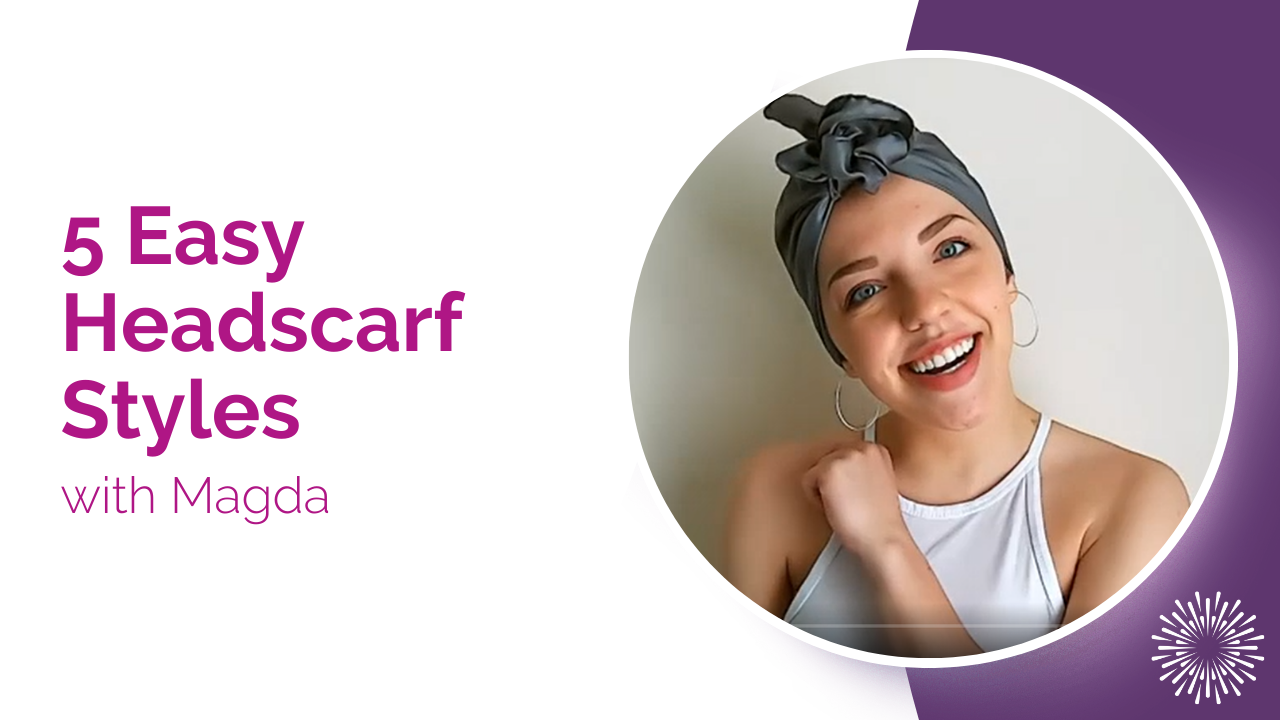
You should know that Look Good Feel Better workshops offer head/scarf wrapping info catering specifically to you and me, so that we can become more comfortable with how to wear our scarves in different ways. There are also lots of scarf-tying tutorials on YouTube, to give you even more ideas. You can start with this from Look Good Feel Better.
It was on Christmas morning — while in the shower, thinking of my children and the celebrations and everything that needed to be done — that I first felt the lump. I wanted to believe it was nothing, just like the doctors had told me before, when I’d had clogged milk ducts while breastfeeding — but deep down, I knew something was different this time.
When I left Bangladesh and came to Canada five years ago with just my husband and two small children, I never dreamed that I’d soon be facing stage 3 breast cancer in a new land, thousands of kilometres away from my family. I felt so very alone. And I had a hard time accepting my diagnosis. I’ve always lived a healthy, disciplined lifestyle. In my family, everyone looked to me as the example of good health — I was the one who knew what foods to eat and how to live the right way. I did everything right, and yet still, I was the one who got cancer. It didn’t seem fair.
I struggled to accept what was happening to me, but one thing was clear: I had no choice but to face whatever was coming. I have kids, I have a family — I wanted to live.
My treatment involved eight rounds of chemotherapy, a lumpectomy, and 19 rounds of radiation. I hid my pain, sickness, and sadness from my husband and son and daughter as much as possible. I didn’t want my husband to lose strength — he had so much on his shoulders, taking care of me and the kids. I had no one to turn to, no one to talk to. I was desperately stressed out and frustrated. And I felt so helpless — I’m a very independent person who suddenly wasn’t able to do much on my own.
Fortunately, I realized that this wasn’t a permanent situation. I knew I would be alright after my treatment, and so I accepted the pain and the reality of what I was facing. I endured the vomiting, nausea, and painful burns from radiation. And little by little, things started to look up. I found support. I found strength. And through the big dark cloud that is cancer, I found small rays of hope.
Every cloud has a silver lining, or as we say in Bangladesh, “shesh bhalo jar, shob bhalo tar” – “all’s well that ends well,” basically. Despite the hardships, cancer brought me unexpected gifts. When my hair grew back after my treatment, for the first time ever it was curly — something I had always wanted. Post-chemo, my skin is so much better. And I got to model again, thanks to Look Good Feel Better (LGFB). In my home country, I had a modelling career, but that all stopped when I came to Canada. Participating in the LGFB photo shoot brought back so many good memories. The feeling of being in the spotlight again was incredible.
Cancer has also made me a better person. I’m much stronger mentally now and I have a deeper sense of gratitude for life. I’m prepared to be a good advisor for anyone else going through a cancer journey. And I really want to contribute, to give back. I want to share my story and my positivity, and to support other cancer patients — especially back in my home country, where cancer treatment resources are limited. In Canada, I got the best cancer treatment possible. But Bangladesh is a developing country, and those who have cancer there are suffering immensely. One day, I hope to return to share what I’ve learned and support those who need it most.
When my doctor told me I needed to fast-track fertility treatments if I wanted to have more children in the future, I was overwhelmed with emotion. I was 33 and suddenly the option of having more children — the spontaneity, the joy of it — wasn’t mine anymore. I didn’t want to tell my partner, who didn’t have any children of his own yet. I felt like I was robbing him of an experience he might have naturally had with someone else, someone who wasn’t going through breast cancer. It made me feel flawed, as though something was wrong with me.
Eventually I did tell my partner, and he was very supportive. He accompanied me to my treatments. But opening up about my diagnosis was hard. In Caribbean culture, especially among the older generation, people tend to be very private about their health. When I found out I had cancer, I wanted to keep the news to myself — even from my partner, family, and friends. But as things progressed, I realized I couldn’t do it alone.
I’d had a lumpectomy years ago, for a benign lump, which I had kept secret. I thought I could do the same this time — have a bit of chemo and downtime and then go back to my regular life and work as a nurse, with no one the wiser. I didn’t want my mother to worry. “Here we go again,” I said to myself. “I can do this.” But this time was different. I didn’t realize how much my treatment would break me down physically. Suddenly, I couldn’t even walk to the bathroom or wash my face on my own. I told my family and they stepped in to help.
My sister was an absolute godsend. She moved in and helped with all the day-to-day stuff — laundry, groceries. But most importantly, she really helped with my 10-year-old daughter. She took her to the movies, did her nails, and took her to her dance lessons and recitals, making sure her life wouldn’t be completely turned upside down.
I had trouble breaking things down and explaining what was going on to my daughter. Kids learn about cancer at school through Terry Fox, so naturally she asked if I was going to die like he did. I couldn’t answer her questions without falling apart, so having my sister there — and also getting my daughter into a children’s support group — was essential.
My treatment — chemo, a mastectomy, radiation, and IV therapy — took everything from me physically, mentally, and emotionally. I felt like cancer had stripped me bare, leaving me with no say, no control, nothing.
And then I was introduced to Look Good Feel Better (LGFB). Honestly, I wasn’t going to go. I was feeling awful and I didn’t want to socialize. I was very closed off and isolated. But I put my fear aside and attended the workshop, and I’m so grateful I did. The air felt so loveable when I got there — so welcoming, inviting, uplifting, and warm. It ended up being the most amazing experience. Everyone was talking and joking around, being so supportive. I didn’t expect to feel beautiful when I walked out. LGFB is like a sisterhood. When I was feeling broken and bare, it lifted me up and helped me to feel loved.
Today, I’m getting used to a new normal. I’ve had to accept that I’m never going to feel the way I did before cancer. But I’ve also realized that it’s okay to lean on others and to find strength in sisterhood.
One question everyone may have as they begin their cancer treatment is ‘what are the side effects of my cancer treatment?’ The truth is, is that, while there are many common side effects from chemo, radiation, immunotherapy and drugs, your treatment experience will be different from anyone else. So, what’s ‘normal’? Your medical team may give you a booklet on what to expect, but the reality is, there is no ‘normal’.
Hair loss, fatigue, constipation, diarrhea, headache, nausea are all common side effects from cancer treatment. But you may also be dealing with loss of balance, strength and coordination. Others experience nerve tingling, “burning” or numbness. It’s also possible that you may not have any of these side effects. Your reaction to your treatment is as individual as your diagnosis itself.
In the past, a good patient was often described as someone who kept questions to a minimum, who followed all the advice that their healthcare professional provided, who didn’t complain or voice their concerns, and didn’t speak out about something they didn’t understand. Over the years, medical professionals have begun to realize that their patients are individuals, with minds of their own and ideas and questions about their own healthcare.
Enter, Dr. Margaret Fitch, a professor at the University of Toronto with a background in nursing and expertise in oncology and the psychosocial and emotional side of cancer. Dr. Fitch identifies the difference between ‘person-centered’ and ‘patient centered’ care. Your care is a partnership. Doctors, nurses and social workers bring knowledge and expertise, but you are the expert on you and your personal experience. Person-centered care calls on medical professionals to listen, work in partnership with you and to better understand what your life is like and to pay close attention to how any suggestions made may impact you.
Dr. Fitch offers some important take aways to help you in your efforts to ensure your care is ‘person-centered’.
Embrace Your Right to Ask Questions: It’s crucial to remember that you have the right to ask questions about your care and treatment. Even if it’s difficult to speak up, your health and well-being are paramount. Take time at home to write down your questions when you’re relaxed, and bring them to your appointments. Don’t hesitate to be firm and confident in asking for the information you need.
Utilize All Available Resources: While your time with your physician is limited, don’t hesitate to ask a nurse or another healthcare professional for additional support. Healthcare teams often work together, and they can help ensure that your concerns are addressed. It’s okay to use multiple strategies to get the information and support you need.
Understand That “Normal” Doesn’t Mean “Okay”: If you’re told that certain side effects or feelings are normal, it’s important to recognize that this doesn’t mean you have to accept them without support. There is help available, and you don’t have to navigate these challenges alone. Speak up about what you’re experiencing and ask about the resources and services that can provide relief.
Recognize the Uniqueness of Your Experience: Cancer is not just one disease, but many, each with its own treatments and side effects. What you go through may be completely different from someone else’s experience, even if the diagnosis sounds similar. Don’t feel pressured to compare your journey to others; instead, focus on what you need and seek out the right support for your specific situation.
Explore Your Options: The treatment and support options available to you are diverse. Whether it’s joining a group, seeking one-on-one counseling, or trying different therapies, it’s essential to find what works best for you. Don’t be afraid to explore different approaches until you find the one that feels right.
Stay Informed About New Treatments: Medical advancements, like targeted therapies, are constantly evolving. These treatments can be more precise and may reduce some of the more challenging side effects associated with traditional chemotherapy. Keep the conversation open with your healthcare team about new options that may be available to you.
Value Your Individuality: Remember, your journey is uniquely yours. While it’s helpful to hear others’ experiences, what works for someone else may not be the best fit for you. Trust in your instincts, ask for the information you need, and choose the path that feels most supportive to your individual needs and circumstances.
In Episode 2 of “Facing Cancer Together,” you will hear from several women undergoing treatment, each with their own unique version of ‘normal.’ Additionally, Dr. Fitch delves into the concept of ‘person-centered care,’ offering deeper insights into this compassionate approach to treatment. Tune in for a compelling discussion that highlights the diverse experiences of these women, the importance of personalized care and how you can advocate for yourself during your own cancer journey.
I’d already survived a life-changing event when I was just 16 years old. It was the first day of summer. I was fresh out of grade 10 and excited to be doing my very first parachute jump. But the parachute didn’t open, and I plummeted 3,000 feet to the ground. The impact left me with a spinal cord injury, and I’ve used a wheelchair ever since.
I was able to move on with my life I went back to school and got a university education. I got married and had a daughter, who’s in her 30s now. I had a fulfilling career as a French immersion teacher. I also got very involved in wheelchair sports, from curling to hand cycling. My life was moving forward in a positive, productive way.
I thought that surely my spinal cord injury was the biggest challenge that life would throw my way. Cancer had never been on my radar. I was feeling great. When I discovered the lump, I didn’t panic. I’d been getting regular mammograms with nothing showing up. But when the nurse called and said, “There’s a 97.5% chance it’s malignant,” everything changed. It felt like the world had shifted beneath me once again, just like that day in 1981 when my parachute failed.
My breast cancer diagnosis was shocking. It was an aggressive cancer with all these names I’d never heard before: ER-positive, PR-positive, and HER2-negative. I had no idea there were so many forms of breast cancer. And it felt extremely unfair. I had already been dealing with a spinal cord injury for most of my life – wasn’t that enough? Hadn’t I experienced enough traumatic moments? I was also initially very concerned that I was not going to survive, as I’d watched my mother die of cancer. I was devastated.
My spinal cord injury changed my life, but cancer was even worse. It wasn’t just physically brutal – it caused an immense emotional toll, invading all aspects of my life and leaving me constantly on edge, with the steady fear of recurrence looming over me. And navigating the complexities of cancer care treatment was especially challenging because of my spinal cord injury. For example, the chemo table was too high for me to get up onto on my own. I had to lobby the hospital for better accessibility.
In the past year, I’ve gone through a lumpectomy, what felt like endless chemotherapy, radiation, and ongoing hormone therapy. I’ve gone from having long blond hair to short grey hair with chemo curls. I still don’t recognize myself when I look in the mirror. It’s like I’m a different person now, in many ways.
Amid the whirlwind of treatments and fear, finding support became essential. Having an organization like Look Good Feel Better (LFGB) was so helpful. Peer support is one of the big methodologies used to help people with spinal cord injuries. You can have a doctor explain about the injury and physiotherapy and occupational therapy, but peer support – meeting someone else living with the same condition – is often far more valuable. It was the same with having cancer. When I got my cancer diagnosis, I didn’t have any friends or colleagues who were going through it. I didn’t feel like there was much of a community or people I could speak with. No one in my family had had this diagnosis or any type of cancer treatment. I found that sense of peer support from LGFB’s workshops – peers getting together, and volunteers who are well-versed in cancer treatment. For me, the more I can meet others going through similar circumstances, the easier it is to go through the experience. I’m not alone. I’m part of a shockingly large community of women dealing with the same thing. This is an additional piece to the recovery process.
Other things that have helped in my recovery and my holistic approach to treatment are taking care of my appearance, staying active in my communities, and travelling. I’m aware of my mortality in a new way now. I no longer put things off. Cancer has taught me to live each day with intention and gratitude, embracing each moment to the fullest.
When I think back to having cancer and going through treatment, a lot of it is a blur. It was almost like a four-month-long out-of-body experience. I was 15 and in grade 10 when I was diagnosed. I was in the culinary arts program at my school in Toronto, which I had wanted to do forever. And so much was already going on in my life. It was a tough year. My dog had recently died, which was really hard for my family, and my grandmother had also had a cancer scare. And, things were hard at school. I’d met someone who turned out to not be a very nice friend, so I stopped hanging out with him and then I found out a few months later that he’d been writing mean stuff about me online. And then he started threatening me and following me around school. He was friends with a lot of my friends and it was hard to get away from him. And I had also just parted ways with my entire friend group, because they were just not nice friends. One of them even told me she had hated me from the moment she met me. That was hard. I’d dealt with a lot that year, and so getting cancer just kind of felt like an extra bonus. It was the cherry on top of some terrible sundae.
Suddenly I was spending pretty much every single day, hours and hours of the day, in doctors’ offices trying to figure everything out. I started failing most of my classes at school because cancer was suddenly taking up most of my time.
I got through it, though. My school supported me with my class work when they heard what was going on. I was able to make some great new friends who were kind and supportive. And I got through my treatment.
Chemo was hard but it wasn’t as bad as movies would make it seem. In some ways it’s true that chemo can be very intense, but it wasn’t as scary as I thought it was going to be. My surgery went really well. Heading into it, my parents were super nervous, but I was just like, “OK cool, I’ll see you guys later!”
My hair did fall out, which was not fun. I had really long curly hair, and I was sad to lose it. And I had a lot of skin problems – sore skin, chemo blisters that turned dark purple on my feet, a lot of sensitivity in my hands, and red marks on my shoulders. Doing a Look Good Feel Better workshop helped me feel a lot better. I loved not just playing with makeup – I love getting to express myself in that way – but also getting to meet other people who had cancer. They told me about their experiences, which was really helpful for me. It made me feel less alone.
That’s all behind me now, and I get to focus on being a teenager and doing what I love. I still enjoy being creative in the kitchen. Baking is my favourite. I’m really good at making chocolate cake – I think I’ve perfected it. I also like to crochet, embroider, sew, and do crafts. I’m glad that this is my life again, and that cancer is in my past.