
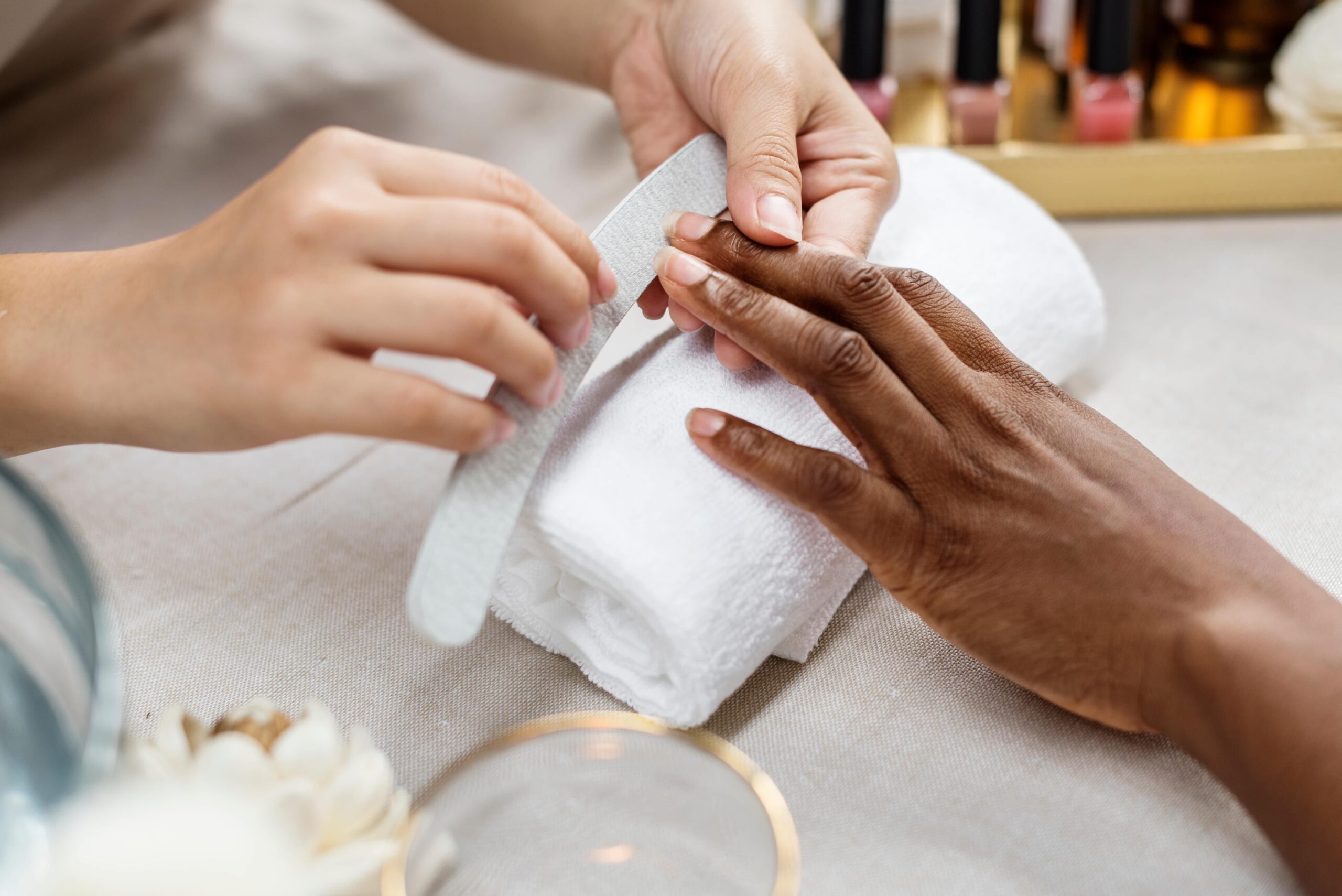
Tips to keep your hands and feet healthy:
-
Avoid cutting your cuticles. Instead, use cuticle cream to help combat dryness, splitting and hangnails.
-
Moisturize with a rich hand cream.
-
Keep nails short.
-
Wear rubber gloves while doing chores as excessive exposure to water can lead to fungal infection of the nail bed.
Nail Polish and Nail Salons
If you’d like to use polish, soft, neutral shades of pink will lend a healthy- looking finish
Use an oily acetone-free polish remover. Acetone is very drying and can make nail problem worse during treatment
When visiting a salon, make sure the staff has worked with clients undergoing cancer treatment (or at least knows how to take extra precautions to keep you safe and healthy)
Let’s navigate this together
Join a community that understands. Receive expert advice, useful resources, and compassionate tips throughout your cancer journey in the LGFB newsletter
Newsletter Form
Before applying or removing makeup or skincare products…
Wash your hands thoroughly in lukewarm water with antibacterial soap
Use a disposable hand cloth or a clean towel to dry your hands. When on the go, use travel-size hand sanitizers to protect against germs.
Only use clean hands or clean disposable cotton balls, pads, sponges, cotton swabs, or cosmetic spatulas to apply cosmetics
Throw them away after each use
Once treatment is over, you can switch back to your regular makeup brushes. But, make sure they are cleaned often with a mild soap or a specialty brush cleaner.
Product Hygiene Best Practices
Reduce the Exposure to Germs
- When you can, use products with pump dispensers (rather than things in pots or jars)
- If not, use spatulas to remove the product from containers to avoid transferring germs back into the product
- Close all lids tightly and promptly after use
- Don’t ‘double dip’ with a used applicator
- Never blow on applicators or products
- Avoid sharing personal care products – even with close friends or family members
- When purchasing, test products on your hand or wrist, not on your face
Sanitizing Makeup Products
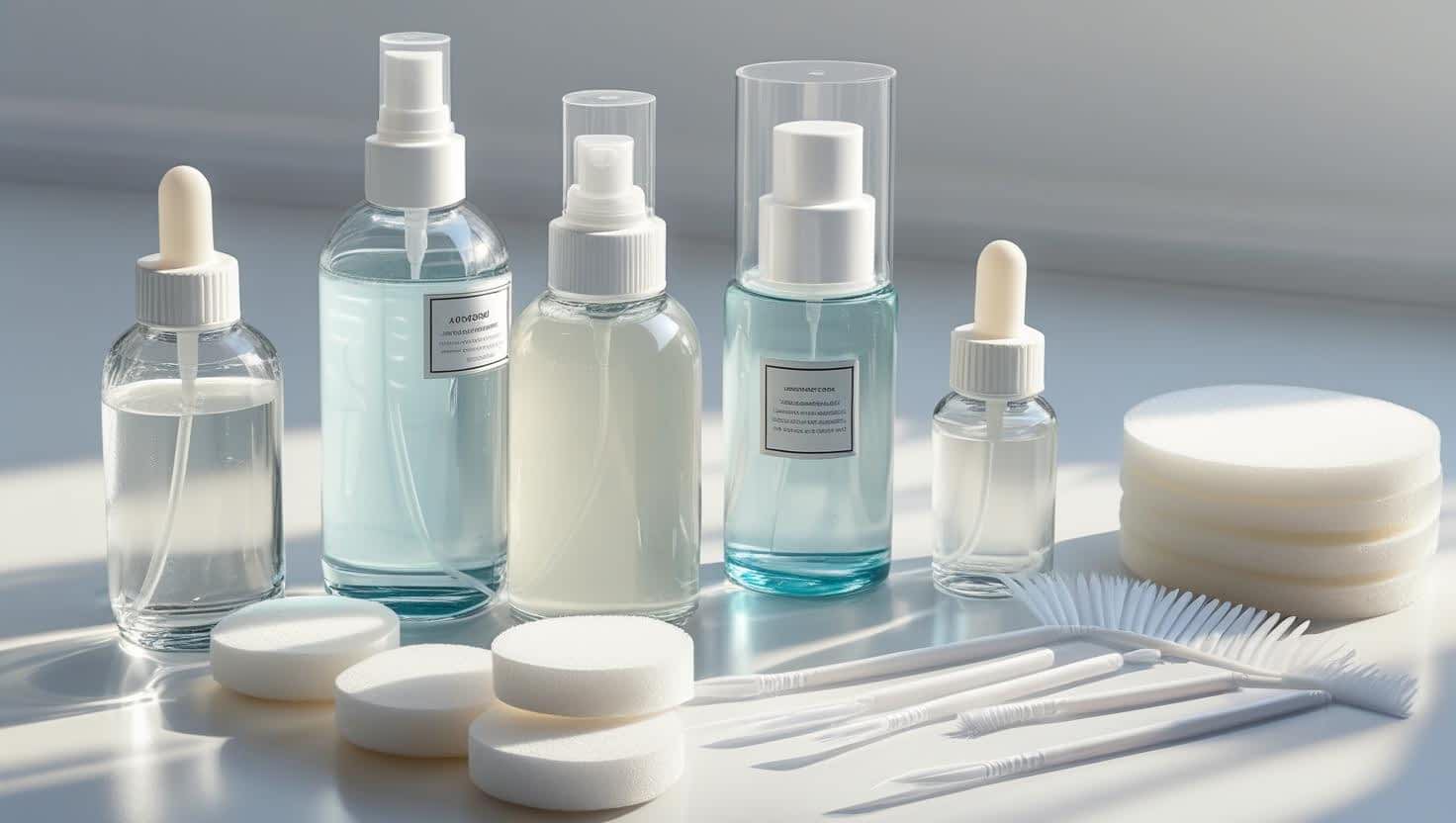
Put 70% isopropyl alcohol (IPA) in a small spray bottle. You can use this to disinfect most of your makeup products. Use a light spray and wait at least 30 seconds until it’s dry.
- Powders and palettes: Spritz the powder directly on the product and let it air-dry
- Liquid foundation: Dip a cotton round into rubbing alcohol and clean the bottle’s nozzle and cap thoroughly
- Eye and lip pencils: Spritz alcohol on the tip before and after sharpening and before each use
Let’s navigate this together
Join a community that understands. Receive expert advice, useful resources, and compassionate tips throughout your cancer journey in the LGFB newsletter
Newsletter Form
It was on Christmas morning — while in the shower, thinking of my children and the celebrations and everything that needed to be done — that I first felt the lump. I wanted to believe it was nothing, just like the doctors had told me before, when I’d had clogged milk ducts while breastfeeding — but deep down, I knew something was different this time.
When I left Bangladesh and came to Canada five years ago with just my husband and two small children, I never dreamed that I’d soon be facing stage 3 breast cancer in a new land, thousands of kilometres away from my family. I felt so very alone. And I had a hard time accepting my diagnosis. I’ve always lived a healthy, disciplined lifestyle. In my family, everyone looked to me as the example of good health — I was the one who knew what foods to eat and how to live the right way. I did everything right, and yet still, I was the one who got cancer. It didn’t seem fair.
I struggled to accept what was happening to me, but one thing was clear: I had no choice but to face whatever was coming. I have kids, I have a family — I wanted to live.
My treatment involved eight rounds of chemotherapy, a lumpectomy, and 19 rounds of radiation. I hid my pain, sickness, and sadness from my husband and son and daughter as much as possible. I didn’t want my husband to lose strength — he had so much on his shoulders, taking care of me and the kids. I had no one to turn to, no one to talk to. I was desperately stressed out and frustrated. And I felt so helpless — I’m a very independent person who suddenly wasn’t able to do much on my own.
Fortunately, I realized that this wasn’t a permanent situation. I knew I would be alright after my treatment, and so I accepted the pain and the reality of what I was facing. I endured the vomiting, nausea, and painful burns from radiation. And little by little, things started to look up. I found support. I found strength. And through the big dark cloud that is cancer, I found small rays of hope.
Every cloud has a silver lining, or as we say in Bangladesh, “shesh bhalo jar, shob bhalo tar” – “all’s well that ends well,” basically. Despite the hardships, cancer brought me unexpected gifts. When my hair grew back after my treatment, for the first time ever it was curly — something I had always wanted. Post-chemo, my skin is so much better. And I got to model again, thanks to Look Good Feel Better (LGFB). In my home country, I had a modelling career, but that all stopped when I came to Canada. Participating in the LGFB photo shoot brought back so many good memories. The feeling of being in the spotlight again was incredible.
Cancer has also made me a better person. I’m much stronger mentally now and I have a deeper sense of gratitude for life. I’m prepared to be a good advisor for anyone else going through a cancer journey. And I really want to contribute, to give back. I want to share my story and my positivity, and to support other cancer patients — especially back in my home country, where cancer treatment resources are limited. In Canada, I got the best cancer treatment possible. But Bangladesh is a developing country, and those who have cancer there are suffering immensely. One day, I hope to return to share what I’ve learned and support those who need it most.
It was in the middle of a day doing something I love — golfing — that I finally had to admit to myself that something was wrong. I couldn’t even swing the club — the pain in my back had become unbearable. I went to get it checked out, and soon what I had already known deep down was confirmed: my breast cancer had returned, spreading to my bones.
Now, at 54, I’m facing a stage 4 diagnosis. I’ll be on treatment for the rest of my life. But here’s the thing — I’m not one to dwell on doom and gloom. As a Christian, I believe I’ll eventually go to heaven and have an eternal life. In the meantime, I’m determined to live life with grace, strength, and, most importantly, gratitude.
My cancer journey began in September 2020, during the height of the pandemic. I had noticed a lump in my breast and, after some tests, received the diagnosis that no one wants to hear: stage 2 breast cancer. I soon found out that I actually had cancer on both sides, which my doctor said wasn’t common. I always said, “It is what it is.” I worked for an insurance company, so I knew my odds for this type of thing. And two of my maternal relatives had breast cancer, so it wasn’t really a shock.
The treatments were tough— surgery, double-dose chemotherapy, and radiation. I was off work for a year and a half and was grateful to my workplace for their support, including offering everything I needed to make my time off as comfortable as possible. I was also so grateful to live in a place like Toronto, where so many supports are available.
I joined several Look Good Feel Better (LGFB) workshops, which were online during COVID, and they were so helpful. They helped me feel more like myself again, especially after losing my hair. I learned how to wear wigs and scarves, and how to take care of my skin.
After months of treatment, I was relieved when my treatment ended in May 2021. Life started to feel a little more normal again, but my cancer had been aggressive and deep down I knew there was always a possibility it could return.
When it did, I decided to go back to the Philippines, where I’m originally from, to visit my parents before I started treatment. Their health wasn’t good and they weren’t able to travel. It was so good to see them and to connect. While I was in Asia, I also went to Japan and ate a lot of sushi. And when I came back, I was ready to dive into a new round of treatments.
During my recurrence, I also signed up with LGFB for a second time, but this time for the skincare & cosmetics workshop. I really enjoyed getting to attend the workshop at Sunnybrook Hospital — it felt so much more personal. And I was impressed that they gave me custom skincare and makeup recommendations based on my East Asian skin type. Everybody’s skin is so different, so this really stood out.
Looking good became much more important to me this second time around as well. When I first had cancer, it was during COVID, and no one could go out. But now the world is open again, and I want to be out and about. And for me, if I don’t look well, I don’t want to go out. When I look well, I feel well, and then I’m more likely to go out and socialize, which in turn helps me feel emotionally better. It’s like a cycle — a positive, uplifting cycle.
I choose to focus on the positive. As I move forward in life, my faith reminds me that life here is temporary. Whatever the future holds, I know I’m not alone.
When my doctor told me I needed to fast-track fertility treatments if I wanted to have more children in the future, I was overwhelmed with emotion. I was 33 and suddenly the option of having more children — the spontaneity, the joy of it — wasn’t mine anymore. I didn’t want to tell my partner, who didn’t have any children of his own yet. I felt like I was robbing him of an experience he might have naturally had with someone else, someone who wasn’t going through breast cancer. It made me feel flawed, as though something was wrong with me.
Eventually I did tell my partner, and he was very supportive. He accompanied me to my treatments. But opening up about my diagnosis was hard. In Caribbean culture, especially among the older generation, people tend to be very private about their health. When I found out I had cancer, I wanted to keep the news to myself — even from my partner, family, and friends. But as things progressed, I realized I couldn’t do it alone.
I’d had a lumpectomy years ago, for a benign lump, which I had kept secret. I thought I could do the same this time — have a bit of chemo and downtime and then go back to my regular life and work as a nurse, with no one the wiser. I didn’t want my mother to worry. “Here we go again,” I said to myself. “I can do this.” But this time was different. I didn’t realize how much my treatment would break me down physically. Suddenly, I couldn’t even walk to the bathroom or wash my face on my own. I told my family and they stepped in to help.
My sister was an absolute godsend. She moved in and helped with all the day-to-day stuff — laundry, groceries. But most importantly, she really helped with my 10-year-old daughter. She took her to the movies, did her nails, and took her to her dance lessons and recitals, making sure her life wouldn’t be completely turned upside down.
I had trouble breaking things down and explaining what was going on to my daughter. Kids learn about cancer at school through Terry Fox, so naturally she asked if I was going to die like he did. I couldn’t answer her questions without falling apart, so having my sister there — and also getting my daughter into a children’s support group — was essential.
My treatment — chemo, a mastectomy, radiation, and IV therapy — took everything from me physically, mentally, and emotionally. I felt like cancer had stripped me bare, leaving me with no say, no control, nothing.
And then I was introduced to Look Good Feel Better (LGFB). Honestly, I wasn’t going to go. I was feeling awful and I didn’t want to socialize. I was very closed off and isolated. But I put my fear aside and attended the workshop, and I’m so grateful I did. The air felt so loveable when I got there — so welcoming, inviting, uplifting, and warm. It ended up being the most amazing experience. Everyone was talking and joking around, being so supportive. I didn’t expect to feel beautiful when I walked out. LGFB is like a sisterhood. When I was feeling broken and bare, it lifted me up and helped me to feel loved.
Today, I’m getting used to a new normal. I’ve had to accept that I’m never going to feel the way I did before cancer. But I’ve also realized that it’s okay to lean on others and to find strength in sisterhood.
I’d already survived a life-changing event when I was just 16 years old. It was the first day of summer. I was fresh out of grade 10 and excited to be doing my very first parachute jump. But the parachute didn’t open, and I plummeted 3,000 feet to the ground. The impact left me with a spinal cord injury, and I’ve used a wheelchair ever since.
I was able to move on with my life I went back to school and got a university education. I got married and had a daughter, who’s in her 30s now. I had a fulfilling career as a French immersion teacher. I also got very involved in wheelchair sports, from curling to hand cycling. My life was moving forward in a positive, productive way.
I thought that surely my spinal cord injury was the biggest challenge that life would throw my way. Cancer had never been on my radar. I was feeling great. When I discovered the lump, I didn’t panic. I’d been getting regular mammograms with nothing showing up. But when the nurse called and said, “There’s a 97.5% chance it’s malignant,” everything changed. It felt like the world had shifted beneath me once again, just like that day in 1981 when my parachute failed.
My breast cancer diagnosis was shocking. It was an aggressive cancer with all these names I’d never heard before: ER-positive, PR-positive, and HER2-negative. I had no idea there were so many forms of breast cancer. And it felt extremely unfair. I had already been dealing with a spinal cord injury for most of my life – wasn’t that enough? Hadn’t I experienced enough traumatic moments? I was also initially very concerned that I was not going to survive, as I’d watched my mother die of cancer. I was devastated.
My spinal cord injury changed my life, but cancer was even worse. It wasn’t just physically brutal – it caused an immense emotional toll, invading all aspects of my life and leaving me constantly on edge, with the steady fear of recurrence looming over me. And navigating the complexities of cancer care treatment was especially challenging because of my spinal cord injury. For example, the chemo table was too high for me to get up onto on my own. I had to lobby the hospital for better accessibility.
In the past year, I’ve gone through a lumpectomy, what felt like endless chemotherapy, radiation, and ongoing hormone therapy. I’ve gone from having long blond hair to short grey hair with chemo curls. I still don’t recognize myself when I look in the mirror. It’s like I’m a different person now, in many ways.
Amid the whirlwind of treatments and fear, finding support became essential. Having an organization like Look Good Feel Better (LFGB) was so helpful. Peer support is one of the big methodologies used to help people with spinal cord injuries. You can have a doctor explain about the injury and physiotherapy and occupational therapy, but peer support – meeting someone else living with the same condition – is often far more valuable. It was the same with having cancer. When I got my cancer diagnosis, I didn’t have any friends or colleagues who were going through it. I didn’t feel like there was much of a community or people I could speak with. No one in my family had had this diagnosis or any type of cancer treatment. I found that sense of peer support from LGFB’s workshops – peers getting together, and volunteers who are well-versed in cancer treatment. For me, the more I can meet others going through similar circumstances, the easier it is to go through the experience. I’m not alone. I’m part of a shockingly large community of women dealing with the same thing. This is an additional piece to the recovery process.
Other things that have helped in my recovery and my holistic approach to treatment are taking care of my appearance, staying active in my communities, and travelling. I’m aware of my mortality in a new way now. I no longer put things off. Cancer has taught me to live each day with intention and gratitude, embracing each moment to the fullest.
When I think back to having cancer and going through treatment, a lot of it is a blur. It was almost like a four-month-long out-of-body experience. I was 15 and in grade 10 when I was diagnosed. I was in the culinary arts program at my school in Toronto, which I had wanted to do forever. And so much was already going on in my life. It was a tough year. My dog had recently died, which was really hard for my family, and my grandmother had also had a cancer scare. And, things were hard at school. I’d met someone who turned out to not be a very nice friend, so I stopped hanging out with him and then I found out a few months later that he’d been writing mean stuff about me online. And then he started threatening me and following me around school. He was friends with a lot of my friends and it was hard to get away from him. And I had also just parted ways with my entire friend group, because they were just not nice friends. One of them even told me she had hated me from the moment she met me. That was hard. I’d dealt with a lot that year, and so getting cancer just kind of felt like an extra bonus. It was the cherry on top of some terrible sundae.
Suddenly I was spending pretty much every single day, hours and hours of the day, in doctors’ offices trying to figure everything out. I started failing most of my classes at school because cancer was suddenly taking up most of my time.
I got through it, though. My school supported me with my class work when they heard what was going on. I was able to make some great new friends who were kind and supportive. And I got through my treatment.
Chemo was hard but it wasn’t as bad as movies would make it seem. In some ways it’s true that chemo can be very intense, but it wasn’t as scary as I thought it was going to be. My surgery went really well. Heading into it, my parents were super nervous, but I was just like, “OK cool, I’ll see you guys later!”
My hair did fall out, which was not fun. I had really long curly hair, and I was sad to lose it. And I had a lot of skin problems – sore skin, chemo blisters that turned dark purple on my feet, a lot of sensitivity in my hands, and red marks on my shoulders. Doing a Look Good Feel Better workshop helped me feel a lot better. I loved not just playing with makeup – I love getting to express myself in that way – but also getting to meet other people who had cancer. They told me about their experiences, which was really helpful for me. It made me feel less alone.
That’s all behind me now, and I get to focus on being a teenager and doing what I love. I still enjoy being creative in the kitchen. Baking is my favourite. I’m really good at making chocolate cake – I think I’ve perfected it. I also like to crochet, embroider, sew, and do crafts. I’m glad that this is my life again, and that cancer is in my past.