
” There’s lots of great information. I feel as though the questions I had were answered before I even had a chance to ask them. I’m not happy about the changes to my body, but I am accepting them, and I appreciate the tips and support to help me deal with this.”
- Kathryn R, Workshop Participant
Prefer direct information from a professional?
Try our Bras & Prostheses Workshop today!
Let’s navigate this together
Join a community that understands. Receive expert advice, useful resources, and compassionate tips throughout your cancer journey in the LGFB newsletter
Newsletter Form
Post Surgical Products
Prostheses Basics
Fitting & Clothing Tips
Nightwear & Sleep Support
Care & Maintenance
Skincare During Radiation
Nipple Appearance Options
Access & Financial Help
Let’s navigate this together
Join a community that understands. Receive expert advice, useful resources, and compassionate tips throughout your cancer journey in the LGFB newsletter
Newsletter Form
When to use Breast Forms
There is nothing wrong with wanting to feel like yourself. If you’ve been medically cleared to wear breast forms, then you should wear one whenever you choose to.
Some women use breast forms while waiting for reconstruction
Wearing a breast form may help minimize shoulder droop for some people
They can be worn all the time, just on certain days or during certain activities
Others opt not to have reconstructive surgery and use forms as a long-term option
Lots of other people choose to not wear one at all and “live flat”
Types of Breast Forms
Should you choose to wear a breast form, there are lots of different options out there. They vary in weight, material, size and shape. Take the time to explore your options and find the best one for you. Some are even made specially for exercising and swimming.
Custom made breast forms are also available if you aren’t able to find a shape that works for you.
Breast form varieties include:
Various weights that can be very lightweight or match natural breast weight
Some companies offer forms in different shades to better match skin tones
Partial forms available for lumpectomy
Symmetrical or Asymmetrical to match your natural shape
Special forms for swimming or sports
Different materials including silicone, gel, fiber fill, foam
After Surgery
During the 6-week healing period, you won’t want to add weight or compression to the area. Initial breast forms, which are made of a lightweight, loose fibre, are a good option. Some women like the lightweight fibre of an initial breast form and choose this option as their standard breast form after the recovery period has passed.
Others prefer the weight of a standard breast form as it can feel more what they are used to.
Some women refer to the “hug test” – or what makes them feel most comfortable when hugging another person. Knowing what will work for you will depend on your needs and what makes you comfortable.
Partial Forms
Partial forms or protheses are used after a lumpectomy or lymph node removal. They can also be used several years after a reconstruction to match changes in your other breast due to changes in weight and natural changes over time.
They help balance shape and create symmetry. There are lots of options for every shape and size to match the other breast.
Preparing for a Breast Form Fitting
- Most fittings are more than an hour – call and book an appointment
- Schedule 6+ weeks after surgery
- Ensure you don’t have any swelling to find a proper fit
- Wait until there’s no drainage at site
- You should be completely healed: no wounds or bandages
- Bring a fitted t-shirt to test how your bra looks underneath it
Nervous about going into a retail breast form shop?
Consider asking for recommendations from your cancer care centre, friends or family members, or search online. You can also reference Anita Canada’s list of certified retailers to find one near you.
Call ahead and ask some of these questions:
Do they carry a full range of products?
Will they explain the differences in products to you?
Do they offer private fitting rooms?
How busy will they be at the time of your appointment?
Is the retailer knowledgeable of various surgery types and treatments?
Let’s navigate this together
Join a community that understands. Receive expert advice, useful resources, and compassionate tips throughout your cancer journey in the LGFB newsletter
Newsletter Form
Breast Forms: Fittings and Retailers
Find a Retailer in your Community
There are many retailers across Canada which carry breast care products. Medical specialist shops are one option and they often carry a large variety of products. Larger departments stores and lingerie stores can carry some mastectomy bras and breast forms too.
Consider asking for recommendations from your cancer care centre, friends or family members, or search online. You can also reference Anita Canada’s list of certified retailers to find one near you. Remember to call ahead to book an appointment and ask questions.
Preparing for a Breast Form Fitting:
Most fittings are more than an hour – call and book an appointment
Schedule 6+ weeks after surgery
Ensure you don’t have any swelling to find a proper fit
Wait until there’s no drainage at site
You should be completely healed: no wounds or bandages
Bring a fitted t-shirt to test how your bra looks underneath it
Nervous about going into a retail breast form shop?
Call ahead and ask some of these questions:
Do they carry a full range of products?
Can you try all of the products on?
Will they explain the differences in products to you?
Do they offer a private fitting room with a full-length mirror?
How busy will they be at the time of your appointment?
Is the retailer knowledgeable of various surgery types and treatments?
Let’s navigate this together
Join a community that understands. Receive expert advice, useful resources, and compassionate tips throughout your cancer journey in the LGFB newsletter
Newsletter Form
Under $100
The average cost of a post-mastectomy bra is under $100.00.
$200 to $500
Prostheses costs can range between $200.00 – $500.00.
Health Care Plan
Depending on where you live, your provincial healthcare plan may reimburse some costs of breast prostheses.
Private Health Insurance
Depending on the plan, they often will cover prostheses as well as post-operative bras once per year.
Let’s navigate this together
Join a community that understands. Receive expert advice, useful resources, and compassionate tips throughout your cancer journey in the LGFB newsletter
Newsletter Form
What to Wear During Radiation and/or After Breast Surgery
It’s possible you’re feeling a mix of different emotions during treatment or after a mastectomy or lumpectomy. As your body continues to change, your relationship with your body may as well.
Right After Breast Cancer Surgery & During Radiation Treatment
For the first four to six weeks, it is best to opt for: compression-free & wire-free bras and camisoles.
Compression and wire-free bras are often made from soft fabrics and known as ‘leisure bras.’ When shopping for a leisure bra online or in-person, look for something that closes in the front rather than the back.
After a mastectomy your body is still in recovery, and it can be difficult to pull anything over your head or reach behind to clasp the bra. If it is possible to try the garment on, ensure that the bra fits comfortably on the loosest hook. This is so it can be worn looser to begin with and gradually tightened as the swelling goes down.
When to Introduce Breast Forms
A light, fiberfill breast form (also called an initial breast form) can be worn in a bra or camisole if you so choose.
Some initial breast forms allow you to adjust the amount of fill inside to match the size of your other breast if you had a single mastectomy.
"I am having a Lumpectomy."
Follow the information above, however it is good to keep in mind that your medical team may advise you to wear a bra for 24-hours a day for the first week or two after surgery. Like with a mastectomy, look for a bra with:
Soft fabric
No compression
Underwire free
Easy to put on
"Radiation is part of my Care Plan."
Skin and tissue can be sensitive and tender during radiation, so when searching for bras or other garments, look for:
Soft fabric
Underwire free
No compression
Ideally fastens in the front
Other things to consider:
Fitted, but not tight, tank tops made from bamboo cotton offer support and are a great option for many women
While others prefer loose-fitting button up shirts and go without a bra or camisole.
What works best for you might come with some trial and error but having a few different options will be helpful.
You may need to wash the garments often because of regular use of creams and ointments on the treatment site.
"I've had Reconstruction."
Compression bras will be your friend after reconstruction! A compression bra helps to maintain shape and holds the breast(s) in place, preventing pressure points and tissue irritation from forming.
Look for a compression bra made from:
Strong fabric
No seams on the skin
A longer line for comfort
A front closure so you don’t have to stretch to reach a back closure or pull Anything over your head
Lymphedema
Post-Recovery “Everyday Bras”
Recovery time can vary greatly. People can be ready to move into an everyday bra anywhere from two months to one year after treatment is complete.
Mastectomy bras are available in many styles including lingerie, sport and everyday bras. These are specific for post-mastectomy or post- lumpectomy because they come with pockets to hold breast forms. Many have a higher neckline for support and to help cover scars.
If you sew, or know someone who can, you can have pockets sewn into any bra as well – but you may need to experiment a bit to get the right design to hold the breast form.
Remember that your size and shape may have changed post-treatment and post-surgery. A specialized bra retailer can help you find the right size – or check out our bra-fitting tips on our Breast Form Fitting and Bra Tips page.
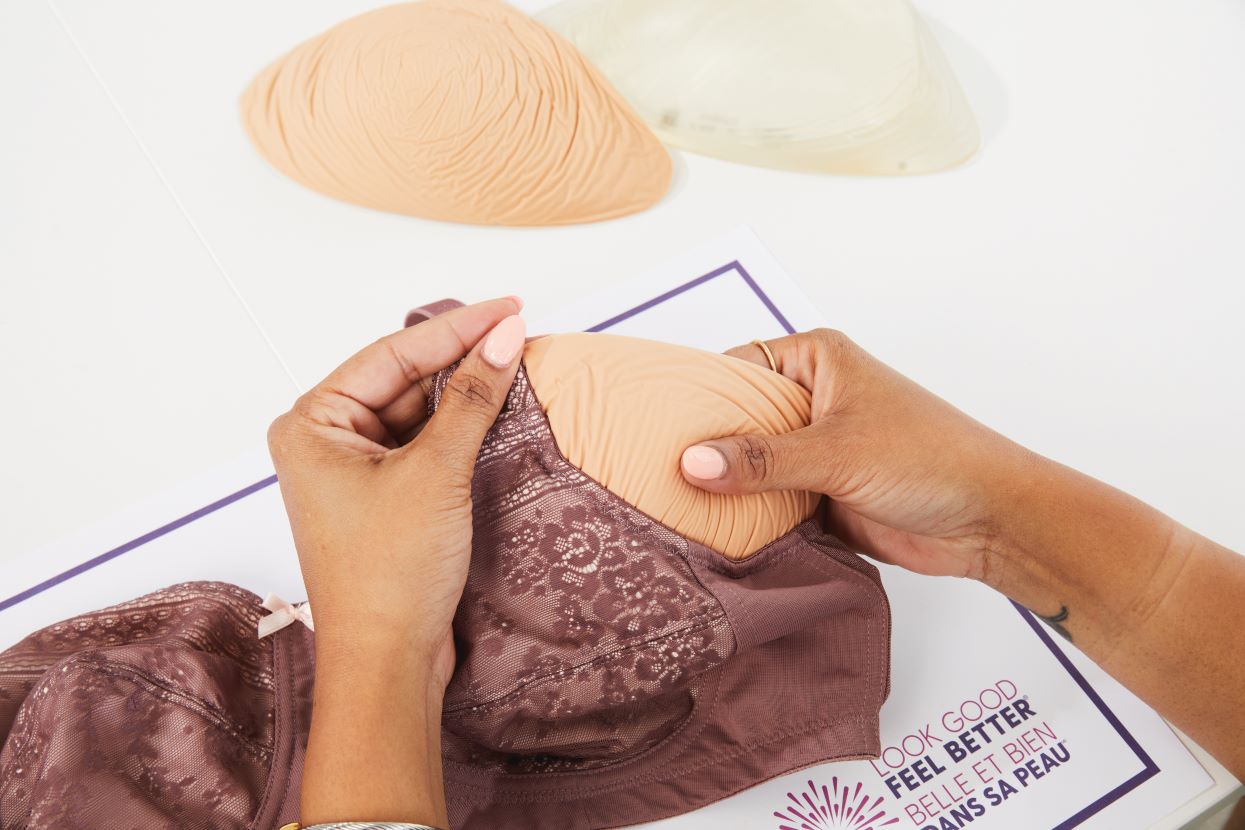
Still have questions?
Get practical advice and connect with people who understand in our Bras & Prostheses Workshop.
Let’s navigate this together
Join a community that understands. Receive expert advice, useful resources, and compassionate tips throughout your cancer journey in the LGFB newsletter
Newsletter Form
What Breast Form is Right for You?
Here’s what to consider based on your unique journey:
Had a mastectomy? Soft, wire-free bras or camisoles with front closures can be gentler on healing skin. Some come with built-in pockets for drainage tubes or breast forms.
Had a lumpectomy? Your medical team may recommend wearing a bra 24/7 for the first week or two. Look for soft, seamless, and wire-free options that offer gentle support without compression.
Going through radiation? Skin sensitivity is common, so breathable, seamless fabrics are key. Bamboo cotton tanks or front-closing wire-free bras help minimize irritation.
Had reconstruction? Compression bras provide support, reduce swelling, and help maintain breast shape during recovery. Look for strong, seamless fabrics with a longer band for added comfort.
Considering a breast form? Some women use breast forms while waiting for reconstruction, as a long-term option, or just for certain occasions.
Considering “Living Flat?” Many people choose not to wear forms or have reconstructive surgery. They feel comfortable with their body after surgery and decide to live as they are. Talk it through with your healthcare team, friends, family, or other participants in our workshop.
Want to talk with the pros?
Get personalized guidance and support in our Bras & Prostheses Workshop.
Let’s navigate this together
Join a community that understands. Receive expert advice, useful resources, and compassionate tips throughout your cancer journey in the LGFB newsletter
Newsletter Form
I thought I had moved on. I thought that my cancer journey was behind me — far in the past. When a routine mammogram led to a new breast cancer diagnosis in 2023, it was a complete shock. My cancer had recurred after 13 years.
At first, I beat myself up over the diagnosis. I thought I had been doing everything right — eating well, working out, taking care of myself. “What did I do wrong?” I wondered. “How could this have happened?” I started to doubt my every move, every bite that I put in my mouth. My self-confidence declined. But I quickly realized that blaming myself wasn’t going to help. I had to act. I needed to take back control.
This time, I chose a double mastectomy with reconstruction. It felt like the safest option — I didn’t want to rely on mammograms anymore. And although I was reluctant to undergo chemo again after my painful first experience, I knew it was necessary. Thankfully, the treatment was a little easier this time. I received a new scalp cooling treatment that helped prevent hair loss, which made a huge difference for me emotionally. Though the chemo still brought its challenges — nausea, fatigue, and rashes — keeping some of my hair helped me feel like I hadn’t completely lost myself to the disease. Scalp cooling was a new innovation that hadn’t been available to me the first time around, so I was grateful for the opportunity to try it out.
Building a support system was also a priority for me. I’m from Mauritius, a tropical island off the coast of South Africa, and most of my family is still there, so I had to create my own network here. I discovered Look Good Feel Better (LGFB), and attending their workshop made a huge difference. My “look” is very important for me, and it was comforting to feel pampered and cared for, especially after all the blows and bad news I’d been receiving. The workshop helped me to regain confidence and connected me to a group of women who understood exactly what I was going through.
I also started a walking group for cancer patients and later joined a dragon boat group for breast cancer survivors. Looking at the strength of these paddlers made me feel strong, too. If they can do it, so can I. It was encouraging. After my first cancer experience, I was eager to move on and forget about it. But now, I realize there’s power in staying connected with the cancer community and with other survivors. I’m a two-time survivor. This is my life and my reality, and I accept it now.
This time, my son also played a bigger role in my recovery. He was just a toddler the first time I had cancer, but now, as a teenager, he became part of my support system. He loves photography, and whenever I did my makeup, he’d take photos of me and edit them. It made me feel good about myself and it became our bonding time, and those photos now hold a special place in my heart.
Today, I cherish every moment with my husband and son. We cook, go for walks, shop, watch movies — those little everyday moments mean everything to me now. I’m grateful for each day and, rather than cry about what happened to me or worry about the future, I choose to live in the present. Cancer may be part of my story, but it doesn’t define who I am.